

Longevity - Why Your Hands Are Telling Your Body How Long to Live !
And before you scroll past that headline, let me ask you something.
When was the last time someone looked at your hands, really looked at them, and told you they were a window into your cardiovascular health? Your brain? Your very longevity?
Probably never. But here's the thing: the science has known this for a while. And as a personal trainer, it's one of the most fascinating, underused, and genuinely empowering pieces of research I share with every single client.
So let's talk about grip strength. Not as a party trick. Not as an arm-wrestling bragging right. But as one of the single most predictive markers of how long — and how well — you're going to live.
The Handshake That Changed Medicine
In 2015, a landmark study published in The Lancet tracked over 140,000 people across 17 countries and found something that stopped cardiologists in their tracks: grip strength was a stronger predictor of cardiovascular death than blood pressure alone.
Read that again. Your handshake, the firmness with which you grab a dynamometer for a few seconds, predicts your risk of heart attack better than one of medicine's most classic vital signs.
But wait. It gets deeper.
Further research has linked low grip strength to increased risk of: premature all-cause mortality, cognitive decline and dementia, hip fractures and falls in older adults, longer recovery times after surgery, depression and reduced quality of life. This isn't a coincidence. It's a signal.
Why Your Grip Is a Report Card for Your Whole Body
Think of your body as an electrical grid. Your muscles, all of them, from your forearms to your calves, are substations. Grip strength is one of the clearest indicators of overall muscle quality and nervous system efficiency across the entire grid.
When you squeeze something hard, you're not just using your fingers. You're activating a cascade: forearm flexors, shoulder stabilisers, core engagement, and a complex network of neural signals firing at speed. Strong grip = efficient, well-maintained grid. Weak grip = flickering lights.
Muscle mass, and the neurological capacity to actually use it, is one of the most powerful anti-aging tools we have. And grip strength is its most accessible, measurable proxy.
The Numbers That Should Wake You Up
The average healthy grip strength for an adult male is 46–56 kg of force (right hand). For women, it sits around 27–36 kg.
But here's what the research on aging tells us: we lose roughly 1–3% of grip strength per year after our 40s if we do nothing. That sounds small until you do the math. A decade of inactivity and you've potentially lost 20–30% of your grip capacity, and with it, a significant slice of your protective health margin.
The good news? That trajectory is not fixed. It is entirely, stubbornly, beautifully trainable.
How to Actually Train It
 |
Let's be honest: most "grip strength tips" online are disappointing. Stress balls. Hand exercises. Forearm curls with a 2kg dumbbell. You deserve better than that. Here's what actually moves the needle: |
1. Kettlebell Swings and Heavy Deadlifts
Every rep is a negotiation between physics and your fingers. As that bell swings forward, its weight wants to fly, and your hands are the only thing standing between you and a broken window. That demand for dynamic, reactive grip under load is irreplaceable.
Do them heavy. Do them with intention. Three sets of 15–20 swings, three times a week, and your forearms will start talking to you in a language you've never heard before. And if you go for the Deadlift, simply don't use the undergrip.
2. Climbing (Bouldering or Roped)
If kettlebell swings are a conversation about grip, climbing is the full immersion language course. Every wall problem forces your fingers, your tendons, your micro-stabilisers, and your entire kinetic chain to communicate in real time.
The magic of climbing as grip training? You forget you're training. You're too busy solving the puzzle in front of you. That psychological engagement is not a small thing, it's one of the reasons climbers show remarkable hand and forearm development that would take years to replicate in a standard gym.
3. Fingerboards (Hangboards)
A fingerboard is a simple wooden or plastic board with various-sized holds, mounted in a doorframe or above a pull-up bar. You hang from it. That's the whole exercise.
But here's the elegant brutality of it: even 10 seconds on a 20mm edge will challenge grip strength in ways that most gym exercises simply can't reach. Start with the big holds (full four-finger grip). Progress slowly. Your tendons adapt on a longer timeline than your muscles, patience here is not optional, it's protective.
4. Gripballs, Grippers & Plate Pinches
Old-school, dirt-cheap, and devastatingly effective. The Captains of Crush gripper series, has been the gold standard in crush strength training for decades.
Plate pinches are equally valuable: grab two weight plates smooth-side out between your thumb and fingers and hold. For time. Until your hand screams. Then do the other side.
These build the pinch and crush components of grip that swings and hangs don't fully address.
5. Farmer's Carries or Shopping Bag Carries
Grab the heaviest dumbbells or kettlebells you can manage. Walk with them. Don't put them down. This is deceptively simple and profoundly hard, your grip fatigue will arrive before your legs do, which is exactly the point.
Farmer's carries also torch your core, challenge your gait, and build the kind of functional strength that translates directly into everyday life. Carrying shopping bags, lifting luggage, moving furniture, grip strength isn't just for the gym. It's for life.
6. Towel Pull-ups & Rope Climbs
Standard pull-ups use a fixed bar — your grip is passive, reliable, easy. Drape a towel over the bar and grab each end? Suddenly the bar is trying to escape. Every pull requires your hands to actively wrestle the fabric into submission.
Rope climbs take this further, there's nothing more humbling, and nothing more grip-building, than three metres of rope with nothing but your hands and feet between you and the floor.
7. Everyday Life Gripping - See bonus section below
Sorry guys. After I've finished my article. I thought, but why the heck should I specifically train my hands. Everyday life should actually be enough. Well, it depends what you do in every day life. That's why I had to create a little bonus section :).
The Philosophy of the Strong Hand
Here's what I want you to carry away from this, beyond the exercises, beyond the studies, beyond the numbers.
Every time you train your grip, you're doing something that goes deeper than muscle. You're sending a signal through your entire nervous system that says: "I am still in this. I am still holding on. I am not done yet."
And that signal, that defiant, physical declaration of vitality, echoes through your cardiovascular system, your cognition, your hormones, and your mood.
The researchers measuring grip strength aren't measuring your hands. They're measuring your biological age. They're measuring your relationship with physical effort. They're measuring, in a very real sense, how much life you're still investing in living.
So pick up something heavy. Hold it until it hurts. Put it down. Come back tomorrow.
Your future self will shake your hand, firmly, and thank you.
Sources: Leong et al., The Lancet (2015); Celis-Morales et al., BMJ (2018); Bohannon RW, Journal of Geriatric Physical Therapy; American Society for Surgery of the Hand; Volaklis et al., European Journal of Internal Medicine
Bonus Section : Your Daily Life Is Already a Grip Strength Workout. You're Just Not Paying Attention
Here's something nobody tells you in the gym: the world outside its four walls is one of the richest grip training environments that exists. Every door, every jar, every bag, every staircase railing, they're all quietly asking something of your hands.
The difference between someone who's building grip strength and someone who's slowly losing it isn't always what happens during a training session. Sometimes it's what happens during a Tuesday morning, a Sunday in the garden, or a walk back from the supermarket.
So let's talk about real life. Let's talk about the hidden gym that follows you everywhere, and how to use it.
The Jar. The Bottle Cap. The Stubborn Lid.
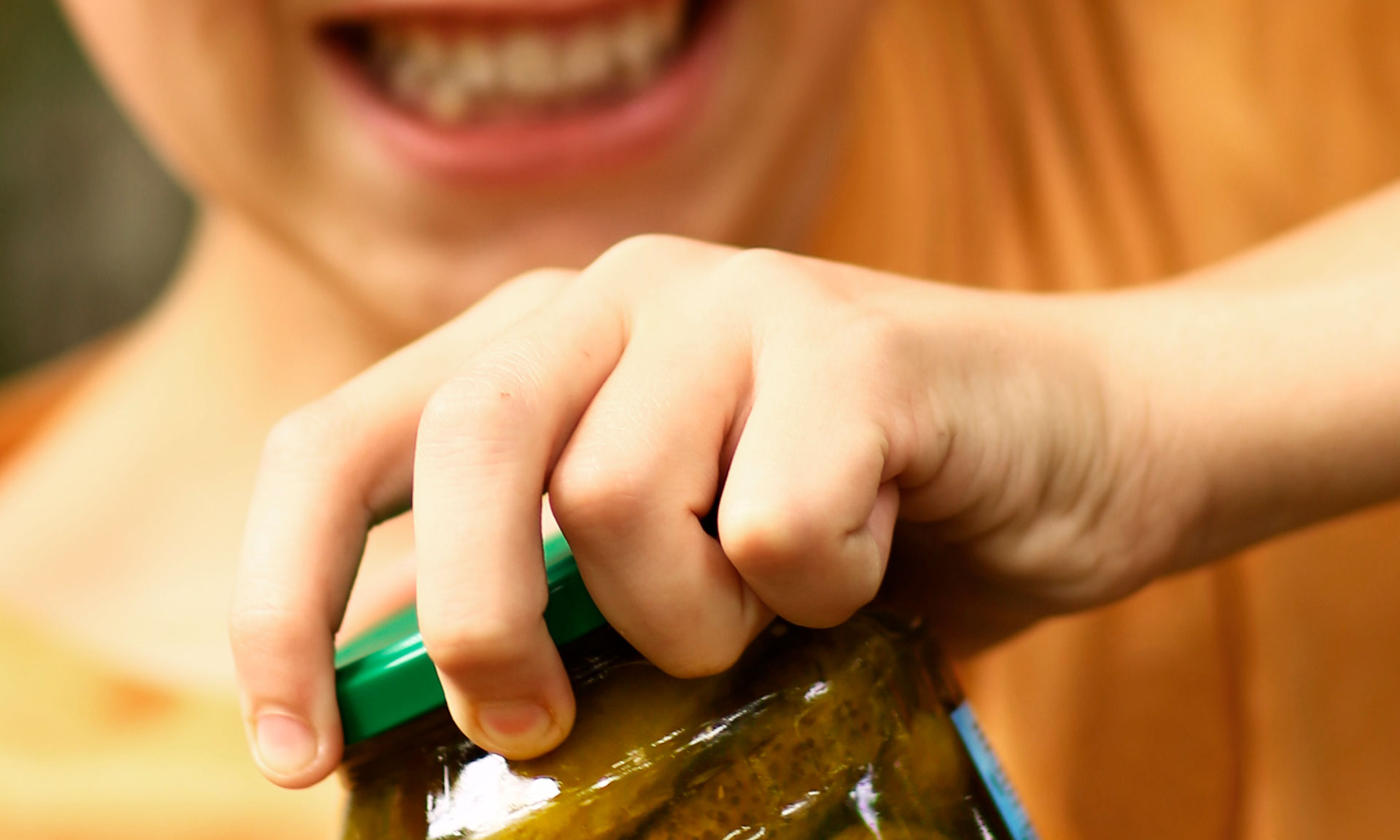
We've all been there. Standing in the kitchen, both hands white-knuckled around a jar of something, face turning the colour of the label, muttering words we won't repeat here.
That moment of resistance? That's grip training. The problem is most people immediately reach for a cloth, a rubber band, or a more capable family member, and in doing so, they quietly opt out of a free set of wrist and forearm work.
The motion of opening a jar is a pronation-supination challenge combined with a crush grip, exactly the pattern that deteriorates fastest as we age, and exactly what makes older adults struggle with pill bottles, tap handles, and key locks.
The fix is almost insultingly simple.
Try before you tap out. Use both hands, yes, but make your hands work. Twist with your whole forearm. Feel the resistance. And once a week, deliberately practice the motion: grab a towel, wring it in both directions as hard as you can. Thirty seconds. That's it. Your future arthritis-free hands will remember.
The Hammer. The Screwdriver. The Wrench.
Any tradesperson, carpenter, or dedicated DIY enthusiast will tell you: after a full day of hand tool work, your forearms are destroyed in the best possible way. There's a reason old craftsmen had forearms that looked like they'd been carved from oak.
Using a hammer properly is a full wrist-and-forearm event. The swing, the impact absorption, the follow-through, all of it loads the extensors and flexors of the forearm in a coordinated, functional pattern that no isolation exercise can fully replicate.
The screwdriver is subtler but more insidious. Driving a screw by hand, especially into hard wood, is one of the most complete rotational grip challenges in the domestic world. It demands control, not just strength, the difference between stripping a screw and driving it flush is entirely in the sensitivity of your grip.
Practical tip: choose hand tools over power tools when you can. Not always, there are jobs that genuinely need a drill. But the next time you're assembling flat-pack furniture or hanging a picture, resist the urge to reach for the electric screwdriver. Your hands are capable. Use them.
The Shopping Bags. Every Single Time.
This one is so mundane it's almost embarrassing to write about. And yet it might be the most consistently available grip exercise on the planet.
Carrying heavy shopping bags, by the handles, in your bare hands, not in a wheeled trolley or a backpack, is a farmer's carry in disguise. You're loading your grip with an asymmetric weight, you're walking, your core is compensating, and your hand flexors are contracting continuously to stop the handles from slipping.
Most people do everything in their power to make this easier: split the weight evenly, use a trolley, make three trips. There is nothing wrong with that for safety or back health.
But sometimes? Make it harder on purpose. Consolidate the bags. Go heavy in one hand. Switch halfway. Walk further than you need to. That ten-minute walk back from the market can quietly become one of the most effective pieces of functional grip training in your week, completely free, completely practical, and zero minutes out of your schedule.
Climbing Stairs With a Railing — And Using It Intentionally
Most people use a staircase railing as insurance, they lightly drag their fingers along it as a reassurance that it's there. As a reflex, not an exercise.
Try this instead: grip the railing firmly as you ascend and descend. Pull yourself up with your arm, not just your legs. Feel the difference in your lat, your bicep, your forearm. On the way down, actively resist your own weight with a controlled grip, like a slow negative on a pull-up bar.
This transforms a neutral daily movement into a low-intensity upper-body session. Do it every day for a month and notice what changes in your shoulder stability, your wrist strength, and your overall upper body awareness.
Carrying Children, Pets, and Heavy Objects From the Boot of a Car
Parents with young children are, whether they know it or not, doing some of the most impressive grip training on earth. A squirming 15kg toddler held under one arm while you fish for your keys with the other hand is a loaded carry, a rotational challenge, and a balance drill all in one.
The same logic applies to lifting a dog crate, hauling a bag of compost, dragging a suitcase up stairs, or carrying a 20-litre water bottle into the kitchen. These moments are not inconveniences. They are opportunities.
The key is how you do them. Don't rush to put things down. Hold them a beat longer than necessary. Switch hands. Carry with your arm extended rather than bent. Every extra second of load time is a free rep.
The Garden. The Spade. The Pruning Shears.
Gardening is one of the most grip-intensive activities a human can do, and almost no one counts it as training. Digging with a spade loads the grip through impact and push-pull cycles. Pruning with shears is pure repetitive crush work, the kind that makes hand therapists nod approvingly. Carrying watering cans. Pulling weeds. Raking leaves.
There is a reason that people who garden regularly well into their eighties often have remarkably strong, functional hands. They never stopped asking their hands to do hard things.
If you have a garden: use it with intention. Don't always use the motorised tools. Pull by hand when you can. Dig a little deeper. Carry the full watering can all the way around.
Writing by Hand. Yes, Really.
This one surprises people, but hear me out. We've largely offloaded the fine motor demands of our hands to keyboards and touchscreens. The intrinsic muscles of the hand, the tiny ones between the knuckles, the ones responsible for fine grip control, get almost no stimulation from modern digital life.
Writing with a real pen, on real paper, with real pressure and real control, reactivates those intrinsic muscles. Journaling, writing letters, sketching all of it contributes to the kind of fine-motor grip health that keeps hands nimble, precise, and pain-free.
And there's a bonus: the research on handwriting also shows benefits for memory, cognition, and focus. So your hands and your brain get the workout simultaneously.
The Secret Truth About Everyday Grip Training
Here's the principle underneath all of this:
Grip strength is not built in the gym alone. It's maintained, or lost, in the ten thousand small moments of every day where you either ask your hands to work, or quietly do it for them.
Every time you use a jar opener instead of your hands, you're making a withdrawal. Every time you choose the wheelie suitcase over carrying it, you're making a withdrawal. Every time you instinctively reach for the power drill instead of the screwdriver, you're making a withdrawal.
None of those withdrawals is catastrophic. But compounded over years, over decades, they add up to hands that have quietly forgotten how to be strong.
The good news? The account is always open for deposits. The interest rate on physical effort is extraordinary. And the teller, your body, is remarkably patient.
Start depositing. Today. The jar is waiting.