
You know that moment in the bathroom mirror, on an ordinary morning, when you notice something you hadn't seen the day before? A line a little deeper. A jawline a little less defined. That particular light your skin used to have, quietly gone missing. You tell yourself "it's age," close the cabinet, and get on with your day. Except — and here's where it gets interesting — age only explains a small part of the story. The rest is cortisol, fascia, misplaced water, and a background inflammation nobody ever explained to you simply. Let's fix that today, together, calmly.
What You See in the Mirror
Before diving into the mechanism, let's recognize ourselves in the picture. Not to scare you — to help you understand that what you're experiencing has a name, a cause, and a solution.
What you're noticing
Deeper wrinkles, sagging face, dull skin, uneven texture, persistent dark circles, puffy face in the morning then hollow by evening, unusual dryness, loss of firmness on the neck.
Notice that last one — puffy in the morning, hollow by evening? That's a huge clue, and we'll come back to it, because it points straight to misplaced water rather than a simple collagen problem.
"Your skin never lies. It just tells a story nobody taught you how to read."
— Patrik
Fascia — Your Forgotten Organ That Holds Everything Together
Here's something very few people know, and it's about to change how you think about your skin for good: your skin isn't just laid over your muscles like a sheet on a bed. It's stitched, literally, to a network of connective tissue that runs down to your bones, wraps every muscle, every organ, every blood vessel. That network is fascia — a kind of full-body gel suit covering absolutely everything, from the soles of your feet to the top of your skull, without a single break.
And here's the aha-moment: when fascia loses its suppleness, thickens, dries out, or sticks to itself, the skin resting on top literally loses its support. It's not just a matter of missing collagen at the surface. It's the whole structure underneath, sagging. Picture a tent: if the poles and ropes (fascia) go slack, the canvas (your skin) drops, even if the canvas itself is in perfect shape.
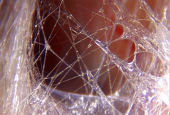
Fascia, that continuous network of connective tissue wrapping and supporting absolutely everything — including your skin. (Guimberteau photo)
Fascia is also connected, from your toes to your skin, through nearly every cell. In other words: the movement you do with your legs this morning has a real, measurable effect on the firmness of your facial skin. Not in some vaguely spiritual sense — in a purely mechanical, circulatory sense. Everything is connected. Really everything.

Tom Myers' fascial lines — continuous chains that literally connect your feet to your face.
Cortisol Strikes Again
If you read the article on Mr. and Mrs. Wake-Up, you already know part of this mechanism — I'll just reconnect it here, specifically for skin. Chronic cortisol does two very specific things to your skin: it actively breaks down existing collagen, and it slows production of new collagen. You lose on both fronts at once.
And that's not all. Cortisol also dries out fascia — literally, it reduces its water content and suppleness. The result: your skin's support structure becomes stiffer, less elastic, less able to cushion and bounce back. It's a bit like comparing a fresh, supple sponge to one that's dried out on the edge of the sink.
Inflammation, Acid-Base Balance and Glycation
Here's a word you may have crossed without quite understanding what it means for your skin: glycation. It's the process where excess sugar in your blood literally sticks to collagen fibers, making them stiff and brittle — a bit like caramel hardening where you should have soft rubber. Once a collagen fiber is "caramelized" this way, it never becomes supple again. It's irreversible.
Chronic low-grade inflammation accelerates this process. And an overly acidic bodily terrain feeds that inflammation. Rebalancing toward a more alkaline terrain — more leafy greens, less sugar and ultra-processed food — is a concrete way to reduce the inflammation that breaks down your collagen day after day.
The Water — Just Not Where You Think
Remember that "puffy in the morning, hollow by evening." Here's the explanation, and it's a real lightbulb moment for many of my clients: there are two types of water in your body. Intracellular water — hydrating your skin from within, making it plump and firm. And extracellular water — stagnating between cells, causing swelling and dark circles without actually hydrating.
Many women drink plenty of water, but it stays stuck outside the cells instead of getting in — mostly because of an electrolyte imbalance (sodium, potassium, magnesium) that drives water transport across the cell membrane.
Celtic salt — an unexpected ally
Unlike refined table salt, Celtic salt naturally contains over 80 trace minerals. A small pinch in your first glass of water in the morning helps these minerals push water into your cells rather than letting it stagnate outside. Visible result over a few weeks: less morning puffiness, plumper-looking skin.
Menopause Changes the Game (And So Does Andropause)
At menopause, the drop in estrogen sharply slows collagen production — up to 30% loss in the first five years. Skin thins, loses elasticity, retains water less well. This isn't an unavoidable fate — it's a real hormonal shift that calls for a more targeted approach. And for any men reading this — andropause has a similar, more gradual, effect via declining testosterone. The same levers apply.
What You Eat Becomes Your Skin
- Bone and cartilage broth. Rich in collagen and glycine — probably the most underrated food for skin. 3 to 4 times a week.
- Vitamin C. Essential to collagen synthesis. Peppers, kiwis, citrus, fresh parsley.
- Quality protein, at every meal. Collagen is a protein.
- Omega-3s. Fatty fish, flaxseed, walnuts.
- Antioxidants. Berries, colorful vegetables, green tea.
- Less sugar, less ultra-processed food. The direct fuel for glycation.
The Movement That Feeds Your Skin From Within
Every muscle contraction literally pumps blood and lymph through your body, delivering oxygen and nutrients to the deep layers of your skin. Strength training also stimulates your growth hormone (HGH) — the hormone most directly involved in tissue repair. To stimulate it effectively: moderate-to-heavy loads, 6 to 12 reps, short rest (60-90 sec), compound movements — squats, deadlifts, pull-ups. Two to three sessions a week is plenty.
Qigong, Tai Chi and Fascia
Every morning, I practice a few minutes of qigong — two to three minutes, no more — and that's enough to release fascial tension throughout my whole body. Concrete result: no more grinding sounds in my neck, joints that free up, a sense of freedom of movement that sets the tone for the rest of the day.
Fascia loves this kind of slow, fluid, multidirectional movement. And since fascia literally connects your entire body, releasing fascial tension globally has a real effect on your skin's tone.
The "glow" — what qigong tradition says
In qigong tradition, practitioners talk about gathering and circulating energy right into the skin, said to literally produce that glow people call "having a healthy look." Whether you subscribe to that energetic view or prefer to explain it through blood flow — the visible result isn't up for debate: regular practitioners often have that particular, luminous complexion.
This is part of why I've woven qigong directly into my personal coaching, and why you'll find it in BeStrong·MoveFree too — on the same level as strength training for HGH.
Face Massage and Lymphatic Drainage
Face massage directly stimulates local circulation and helps release facial fascial tension. Lymphatic drainage tackles the extracellular water problem head-on — gentle movements toward the lymph nodes visibly reduce puffiness and dullness within a few sessions. Five minutes in the morning is enough.
The Concrete Plan
Morning
Cellular reset
A pinch of Celtic salt in your first glass of water. Natural light as soon as possible. Two to three minutes of qigong. Five minutes of face massage or lymphatic drainage.
During the day
Building
Quality protein at every meal, vitamin C, bone broth 3-4 times a week. Move — or a strength session 2-3 times/week, 6-12 reps for HGH.
Evening
Regeneration
Screens off at least 30 min before bed — they literally dry out the skin. Calm wind-down. Bedtime between 9:30 and 10pm for real overnight collagen regeneration.
Taking back control of your skin isn't about a miracle product. It's about understanding what's really happening underneath, and giving your body the right levers, in the right order.
Your skin isn't a problem separate from the rest of your body. It's simply the place where everything else becomes visible.
— PatrikFrequently Asked Questions
How long before I see a difference?
Morning puffiness and glow: 1 to 2 weeks. Firmness and texture: 6 to 12 weeks, the time it takes for collagen turnover.
Does collagen powder actually work?
It helps as support, especially with vitamin C. But without managing cortisol, blood sugar and cellular hydration, you're repairing with one hand what you're undoing with the other.
Is qigong really necessary?
Strength builds and stimulates HGH. Qigong keeps fascia supple and releases accumulated tension. Together, it's complete.