
I want to die young. The latest possible. That's not a contradiction — it's a philosophy. Staying biologically young for as long as you can, then living fully until the end. And at the centre of that goal sits one molecule that most people have never thought seriously about: human growth hormone. Not because you should inject it. Because you should understand it — and use your daily habits to maximise it naturally.
What exactly is HGH?
Human Growth Hormone (HGH) is a peptide hormone produced by the pituitary gland — a pea-sized structure at the base of your brain. It's composed of 191 amino acids and operates through a cascade: HGH triggers the liver to produce IGF-1 (Insulin-like Growth Factor 1), which then acts on virtually every cell in the body. It's the master hormone of growth, repair and regeneration.
During childhood and adolescence, HGH drives skeletal growth. But in adults — and this is what most people miss — it remains essential. It regulates body composition, muscle maintenance, fat metabolism, bone density, immune function, connective tissue integrity, cognitive function and the pace of cellular ageing. Not a minor role.
Exogenous vs natural HGH — the real question
HGH injections exist and are used clinically for diagnosed deficiencies. They're also misused in sport and anti-ageing medicine. The risks of exogenous HGH are real: joint swelling, carpal tunnel, insulin resistance, potential tumour growth acceleration. More fundamentally: when you supply HGH from outside, your pituitary gland reduces its own production. You create dependency.
The question worth asking isn't "how do I get more HGH externally?" It's "how do I get my own body to produce more?" The natural levers are powerful, free, and come with zero side effects. That's what this article is about.
The HGH life cycle — numbers that make you think
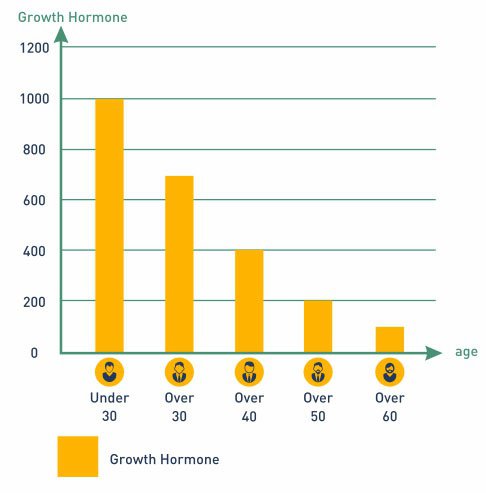
HGH production peaks in adolescence and declines steadily through adulthood. By age 60, most people produce roughly 15-20% of the HGH they produced at 20. That's an 80% decline — and it's not without consequences. The research is unambiguous: declining HGH correlates with loss of muscle mass, increased fat storage, reduced bone density, slower recovery, impaired sleep quality, accelerated skin ageing and cognitive decline.
But here's what the research also shows: much of this decline is not inevitable. A significant portion is driven by lifestyle factors — chronic stress, poor sleep, high insulin, physical inactivity, sugar excess — rather than pure chronological ageing. Which means it's partially reversible.
Men vs women — different profiles
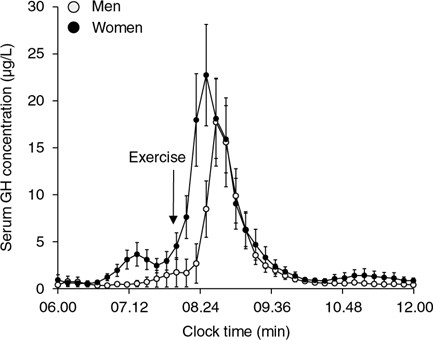
Women naturally produce more HGH pulses per day than men, but in smaller amounts. They also show more variation across the menstrual cycle — oestrogen amplifies HGH secretion, which partly explains why perimenopause and menopause often coincide with significant changes in body composition and recovery capacity. The levers described in this article apply to both sexes — with some nuances for women detailed in the fasting section.
What HGH does for you — a full tour
Muscle — synthesis, recovery, lean mass
HGH stimulates protein synthesis in muscle tissue and activates satellite cells — the stem cells that repair and grow muscle fibres. It also reduces muscle protein breakdown. In practical terms: people with optimal HGH levels gain lean mass more easily, recover faster between sessions, and maintain muscle significantly better as they age. This isn't about bodybuilding. It's about functional capacity — being strong enough to ski, hike, carry bags, and live independently at 75.
Fascia — the often-forgotten connection
HGH stimulates collagen synthesis in connective tissue — tendons, ligaments, joint capsules, and the fascial network that wraps every muscle and organ. This is the aspect most sports medicine practitioners overlook. Adequate HGH means faster tendon healing, more resilient joint structures, and better fascial hydration and elasticity. The stiffness and joint pain many people attribute to "getting older" is partly a HGH deficiency story.
Bone — density and osteoporosis prevention
HGH stimulates osteoblast activity — the cells that build bone. Combined with mechanical load (strength training), adequate HGH is one of the most powerful protections against age-related bone density loss. This matters enormously in the context of fracture risk after 60.
Metabolism — the primary fat-burning hormone
HGH directly stimulates lipolysis — the breakdown of stored triglycerides into free fatty acids for energy. It preferentially targets visceral fat, the metabolically active fat around internal organs associated with cardiovascular and metabolic disease. Optimising HGH doesn't just affect how you look — it addresses one of the most significant health risks of middle age.
Brain, mood and emotional stability
HGH receptors are distributed throughout the brain. Adequate levels are associated with sharper cognitive function, better emotional regulation, improved mood and reduced anxiety. The brain fog and emotional flatness that many people in their 40s and 50s attribute to "stress" or "age" is frequently, at least in part, a HGH story.
Skin — anti-ageing from the inside
HGH stimulates collagen and elastin production in the dermis. Adequate levels mean skin that maintains its density, elasticity and resilience significantly longer. The visible signs of ageing — thinning skin, loss of firmness, deepening wrinkles — are partly a story of declining HGH. No cream addresses this at source. Your pituitary gland does.
Immune function, healing and organs
HGH stimulates the production of immune cells including T-lymphocytes and natural killer cells. It accelerates wound healing, supports organ maintenance and plays a role in gut health through its effects on the intestinal lining. The connection between declining HGH and declining immune competence in later life is well-documented.
What kills your HGH — the saboteurs
High insulin / high sugar diet
Insulin and HGH are physiological antagonists — when insulin is high, HGH is suppressed. Every sugar spike, every refined carbohydrate, every large meal creates an insulin environment that shuts down HGH production. This is the most important dietary factor.
Sleep after midnight
70% of daily HGH is produced in the first deep sleep episode — typically between 11pm and 2am. Going to bed late compresses or eliminates this window entirely. You don't get it back by sleeping longer in the morning.
Chronic cortisol / unmanaged stress
Cortisol directly suppresses HGH secretion. Chronically elevated cortisol — the state most busy adults live in — systematically blunts HGH production around the clock.
Alcohol
Alcohol reduces HGH secretion by up to 70-75% for the duration it's metabolised. It also fragments sleep architecture, eliminating the deep sleep stages where HGH is released. Even moderate evening alcohol dramatically impairs HGH production that night.
Obesity and visceral fat
Visceral fat actively suppresses HGH secretion — the more you have, the less HGH you produce. This creates a self-reinforcing cycle: low HGH promotes fat gain, which further suppresses HGH. Breaking this cycle requires addressing both simultaneously.
Sedentary lifestyle
Physical inactivity removes the primary acute stimulus for HGH release — the metabolic and mechanical stress of exercise. The body has no reason to produce repair hormones if it never needs to repair anything.
Eating late at night
A large meal before bed raises insulin and blocks the HGH window. Ideally, last meal 2-3 hours before sleep, light and protein-focused if late is unavoidable.
Screens and blue light before bed
Blue light suppresses melatonin, delays sleep onset, and reduces deep sleep quality — directly reducing the HGH production window. The 60-minute screen-free window before bed is one of the highest-leverage sleep interventions available.
Exercise and movement — what drives HGH production
Exercise is the most powerful acute stimulus for HGH release available without pharmaceutical intervention. But not all exercise is equal — and understanding the difference changes how you train.
The number one exercise — the legs
Heavy compound movements targeting the largest muscle groups — squats, deadlifts, lunges, leg press — produce the most significant HGH response. The mechanism: high metabolic demand in large muscle groups creates lactate accumulation and acidosis, which signals the hypothalamus to release growth hormone-releasing hormone (GHRH), triggering pituitary HGH secretion. The bigger the muscles involved and the more metabolically demanding the effort, the larger the response. This is why training the legs is non-negotiable for longevity — not just for the legs themselves.
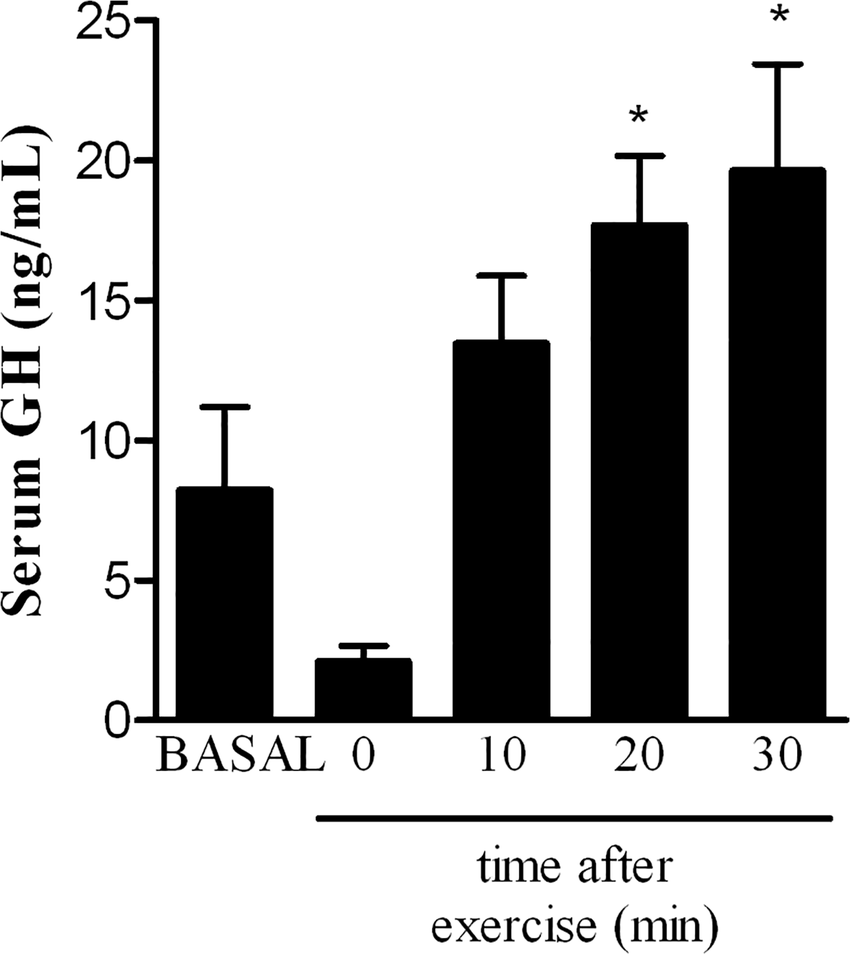
HGH response to exercise is significantly greater with compound movements involving large muscle groups — particularly the lower body.
HIIT and sprints — peak response in 20 minutes
High-intensity interval training produces a larger acute HGH spike than steady-state cardio. 20-30 second maximal efforts with adequate rest periods create the lactate environment that triggers the strongest pituitary response. The key: genuine intensity. Comfortable "cardio" doesn't create the same signal. Six to eight sprint intervals of 20-30 seconds with 90 seconds recovery produces a significant HGH response in under 20 minutes.
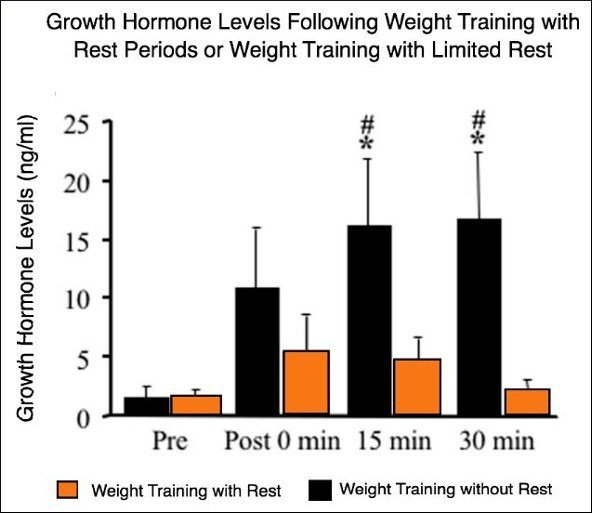
HIIT consistently produces a greater HGH response than steady-state aerobic exercise at comparable duration.
Blood flow restriction (BFR) training — the research surprise
BFR training involves applying light cuffs or wraps to the limbs to partially restrict venous blood return during exercise — allowing full training stimulus with significantly reduced loads (20-30% of maximum). The lactate accumulation it creates, despite the light weights, produces a HGH response comparable to heavy training. This is particularly relevant for people with joint limitations, injury recovery, or older adults for whom heavy loading is contraindicated.
Key training principle for HGH
The stimulus is metabolic stress and lactate accumulation — not simply load or volume. Compound movements, high relative intensity, adequate rest between sessions (HGH is produced during recovery, not during training). Sessions of 40-45 minutes maximum — beyond that, cortisol rises and begins to counter the anabolic response.
Sleep — your nightly regeneration laboratory
Sleep is not a passive state. It's the most anabolically active period of your day — and HGH is the reason.
Circadian rhythms in three sentences
Your body runs on a 24-hour biological clock synchronised primarily by light. This clock governs the timing of every major hormone — including the pulsatile release of HGH. Disrupt the clock (late nights, irregular schedules, excessive artificial light) and HGH secretion becomes erratic and reduced.
When exactly is HGH produced?
HGH is released in pulses throughout the night, with the largest pulse occurring during the first episode of slow-wave sleep (SWS), typically between 11pm and 2am. This is not a fixed window — it depends on when you fall asleep. But here's what matters: the first deep sleep episode produces the largest HGH pulse regardless of timing. Going to bed at midnight means your first deep sleep episode might occur at 1-2am — compressing the window significantly. Going to bed at 10:30-11pm means the first deep sleep episode, and the largest HGH pulse, happens earlier and lasts longer.
HGH is released in pulses during sleep, with the dominant pulse in the first slow-wave sleep episode. Timing of sleep onset directly affects the magnitude of this pulse.
Sleep — optimise the HGH window
Bed before 11pm. Every night that matters.
- Bedroom temperature 18-19°C — core body temperature must drop to enter deep sleep
- Total darkness — even small light sources suppress melatonin and fragment SWS
- No screens 60 minutes before bed — blue light delays melatonin by up to 90 minutes
- No alcohol — suppresses HGH by 70-75% and eliminates SWS
- No large meals within 2-3 hours of sleep — elevated insulin blocks the HGH window
- Magnesium glycinate 300mg in the evening — promotes SWS and reduces cortisol
Natural light, earthing and cold
Morning light — the circadian conductor
Natural light within 30 minutes of waking is the most powerful circadian reset available. It sets the cortisol rhythm (high morning, declining evening), schedules melatonin release at the correct time, and anchors the entire hormonal cascade for the day. A cortisol rhythm that starts correctly means melatonin arrives on time, which means deep sleep happens at the right time, which means the HGH window opens fully. Everything downstream from morning light.
Earthing — free electrons from the earth
Direct contact between bare skin and natural ground — grass, soil, sand, natural rock — transfers free electrons into the body. These neutralise free radicals (a primary driver of cellular ageing) and appear to normalise cortisol secretion. Reduced cortisol means improved HGH production. It's free. It takes 20 minutes. And if you train outdoors, it happens automatically.
Cold exposure
Cold showers, cold water swimming, and cold air exposure all trigger a noradrenaline response that stimulates HGH secretion. A cold shower finish (2-3 minutes) produces a measurable HGH response and cortisol reduction. The Lake Geneva at 18°C in summer is one of the most effective natural HGH stimulants available.
Nutrition and fasting — the nutritional levers
Insulin — the antagonist of HGH
This is the most important nutritional principle in this article: insulin and HGH are physiological antagonists. When insulin is elevated, HGH secretion is suppressed. When insulin is low, HGH can be released freely. Every dietary choice that keeps insulin low — removing sugar, refined carbohydrates, frequent snacking, late meals — is simultaneously a decision to allow more HGH.
The relationship between insulin and HGH is one of the clearest in endocrinology: they cannot coexist at high levels simultaneously.
What supports production
Quality proteins — particularly foods rich in arginine and ornithine (pumpkin seeds, walnuts, almonds, legumes, fish) provide the amino acid precursors for HGH synthesis. Healthy fats (avocado, olive oil, oily fish, eggs) support the broader hormonal environment. Vegetables and fibre regulate blood glucose and insulin.
Intermittent fasting — the most powerful lever after exercise
Fasting produces the most dramatic documented increase in HGH of any natural intervention — up to 2,000% increase in HGH levels during a 24-hour fast (Ho et al., Journal of Clinical Investigation). Even a 16-hour fast produces a significant response. The mechanism is simple: fasting keeps insulin low, which removes the primary inhibitor of HGH secretion. This is more potent than any single exercise session for HGH. Difficult to believe? The studies are unambiguous.
The 16/8 protocol — last meal at 8pm, first meal at noon — is the most practical implementation for most people. The benefits accumulate over time: improved insulin sensitivity, reduced visceral fat, elevated HGH, and the cellular autophagy (cellular cleaning process) that occurs during extended fasting.
Women — some important nuances
The concerns around intermittent fasting and women relate to premenopausal women in the reproductive years, where prolonged fasting can occasionally affect cycle regularity in sensitive individuals. Post-menopausal women tolerate fasting very well — hormones are stabilised and the risk to reproductive function is zero. For premenopausal women, a more moderate 12-14 hour window (finished eating by 8pm, eating again at 8-10am) captures most benefits with minimal risk. The key signal: if energy, mood or sleep deteriorates, shorten the window.
Breaking the fast — the absolute priority
Break the fast with protein first — always. After the fasting window, the body is in a primed hormonal state for muscle repair and fat mobilisation. A protein-rich first meal (eggs, fish, meat, legumes) maintains this environment. A carbohydrate-heavy first meal spikes insulin immediately and erases much of the hormonal benefit of the fast.
HGH, telomeres and longevity
Telomeres — the laces of your chromosomes
Telomeres are the protective caps at the ends of chromosomes — comparable to the plastic tips on shoelaces. Every time a cell divides, telomeres shorten slightly. When they become critically short, the cell can no longer divide and either becomes senescent (dysfunctional but alive) or dies. Telomere length is one of the most reliable biomarkers of biological age — and it can differ dramatically from chronological age depending on lifestyle.
The HGH → IGF-1 → telomere protection link
IGF-1 (produced in response to HGH) activates telomerase — the enzyme that can rebuild and extend telomeres. This is one of the mechanisms through which optimal HGH levels appear to slow biological ageing. It's not theoretical — telomere length differences between active, well-sleeping individuals with optimised HGH and sedentary, sleep-deprived individuals of the same age are measurable and significant.
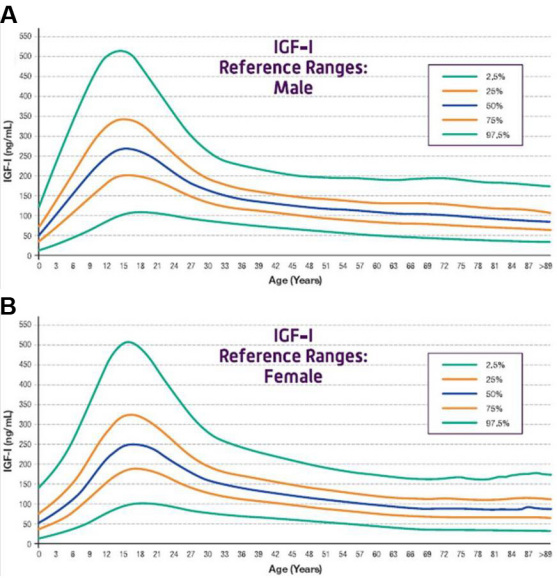
IGF-1, produced in response to HGH, plays a documented role in telomere maintenance — a key mechanism of biological age regulation.
mTOR — the anabolic switch
mTOR (mechanistic Target of Rapamycin) is a cellular signalling pathway activated by mechanical stress (exercise), amino acids (protein), and growth factors including IGF-1. It governs muscle protein synthesis, cellular growth and metabolic adaptation. The deliberate cycling between mTOR activation (training, eating protein) and mTOR inhibition (fasting, rest) appears to optimise both cellular repair and growth — a rhythm that ancestral human life enforced naturally, and modern life often eliminates. Combining fasting with training and adequate protein recovery is therefore not just practical — it's physiologically elegant.
The masterplan — the essentials for staying young
Morning
Light, fasting, low insulin
- Natural light within 30 minutes of waking — no phone first
- Continue the fasting window — water and tea only
- Morning movement (light) is fine — intense training is better done later when protein-fed
- Break the fast at noon with protein first
Training
The most powerful hormonal signal
- 40-minute sessions maximum — compound movements, legs prioritised
- High relative intensity (8-12 reps at 70-80% max) — creates the lactate response
- 2-3 strength sessions per week — recovery is where HGH acts
- 2 HIIT sessions (sprint intervals) per week — not more
- Outdoors where possible — cortisol reduction amplifies the HGH response
Evening
16/8 fasting, protein first
- Last meal by 8pm — light, protein-focused if late
- No sugar, no refined carbohydrates in the evening
- No alcohol — it eliminates the HGH window
- No screens 60 minutes before bed
Night
Bed before 11pm, cold dark room
- Bedroom 18-19°C, total darkness
- Consistent bedtime — the circadian clock rewards regularity
- Magnesium glycinate 300mg 30-60 minutes before sleep
- This is where HGH rebuilds your body. Every night counts.
The 7 things that change everything
- Bed before 11pm. 70% of daily HGH is produced in the first deep sleep episode. Late nights don't just cost you rest — they cost you repair hormones.
- No sugar spikes. Insulin and HGH cannot coexist. Every refined carbohydrate or sugar hit suppresses HGH for hours. The dietary change with the highest HGH return is simply removing sugar and refined carbs.
- 16/8 intermittent fasting. The most powerful natural HGH stimulus available — up to 2000% increase documented. Last meal at 8pm, first at noon. No coffee during the fast — it raises cortisol and counteracts the regenerative purpose.
- Heavy compound training 3x per week. Squats, deadlifts, lunges — the largest muscles, the heaviest loads your form allows. The lactate response is the trigger. 40 minutes maximum.
- Morning natural light. The upstream intervention. Sets cortisol, schedules melatonin, opens the HGH window at the right time each night.
- Eliminate alcohol in the evening. Even one glass suppresses HGH by 70% and fragments deep sleep. This single change, if alcohol is a regular habit, produces measurable improvements in recovery, body composition and energy within weeks.
- Manage chronic cortisol. Cardiac coherence (5 minutes, 3x daily), cold exposure, outdoor movement, adequate recovery between sessions. Cortisol is the most accessible lever for HGH optimisation that most people ignore entirely.
Ageing is inevitable. How fast you age is negotiable.
Frequently asked questions about HGH
Can I increase HGH without supplements or injections?
Yes — and the natural interventions produce results that compare favourably with low-dose pharmaceutical approaches, without the risks. The combination of optimised sleep timing, intermittent fasting, compound strength training and cortisol management has been shown to produce significant, measurable improvements in HGH secretion within 4-8 weeks.
How long before I see results?
The hormonal changes are immediate — HGH rises during the very first fasting window, the very first training session, the first night of properly timed sleep. The body composition and energy effects become noticeable within 4-6 weeks of consistent application. Sleep quality typically improves within 2 weeks of removing alcohol and establishing a consistent bedtime.
Is intermittent fasting safe for women?
For post-menopausal women, yes — fully. For premenopausal women, a moderate 12-14 hour window (eating between 8am and 8pm) is well-tolerated and captures most benefits. More extended fasting (16+ hours) is fine for most premenopausal women but worth monitoring — if energy, mood or cycle regularity changes, shorten the window. The concerns about fasting and women come from studies on very prolonged fasting in sensitive individuals, not from the 14-16 hour protocols most people use.
What's the single most impactful change I can make today?
Remove alcohol in the evening and go to bed before 11pm. These two changes cost nothing, require no equipment, and produce measurable improvements in deep sleep quality and HGH production within days. If you currently have a glass of wine most evenings and go to bed around midnight, this single change is the highest-return intervention available.