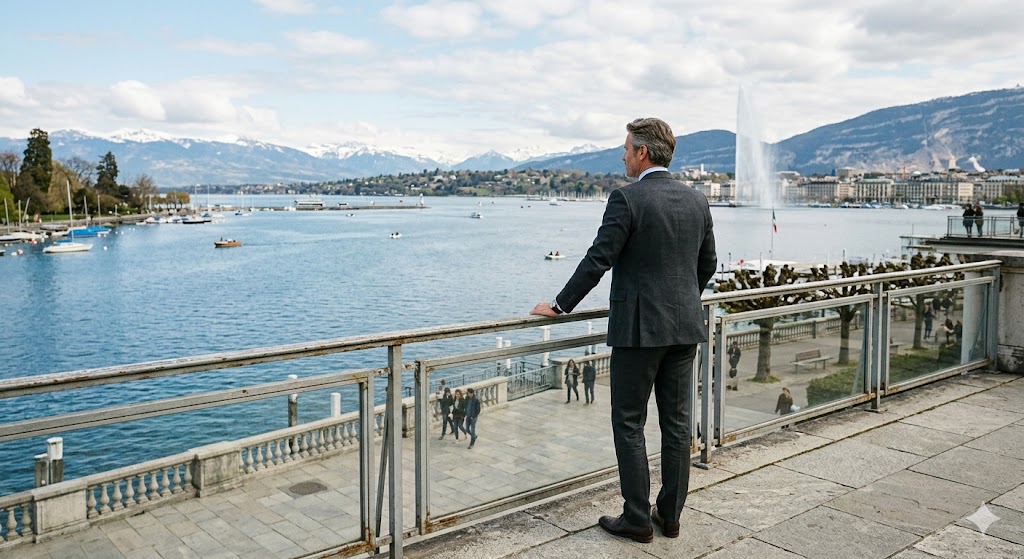
You've done relocations before. You know the drill — new city, new colleagues, new supermarket you can't navigate for the first three months. You're resilient. You've handled bigger things. But here's what nobody warned you about: your body doesn't handle the move quite as gracefully as you do. And by the time you notice the extra weight, the energy that went flat, the sleep that technically happens but doesn't actually restore — it's often been quietly building for months. Sound familiar? Good. Let's talk about it.
I'm Patrik. I coach expats and executives around Lake Geneva — from Morges to Lausanne, Vevey, Montreux and the Chablais. I've been in corporate myself. I've lived in several countries before coming back to Switzerland, where I was born. And after twenty years coaching some of the most high-performing people I've ever met, I can tell you one thing with absolute certainty: the expat body is real, it's specific, and — this is the good news — it's completely reversible. Right. Let's get into it.
The Biology of Uprooting — What's Actually Happening Inside You
You moved to one of the most beautiful places on earth. Your nervous system, though, is still processing the move.
Think of your body as a highly optimised operating system. When everything is predictable — same routine, same food, same social circle, same sleep environment — it runs smoothly. Hormones balanced, cortisol managed, sleep deep, metabolism ticking along nicely. Then you relocate.
Suddenly, every single input changes at the same time. New timezone (even within Europe, the circadian adjustment is real). New food. New social environment. New professional pressures. New apartment, new sounds, new light patterns. Your nervous system can't tell the difference between "exciting new chapter" and "sustained threat" — so it does what it always does under sustained threat: it raises cortisol. Significantly. And it keeps it raised for weeks, sometimes months.
Here's the problem with cortisol at that level — it was designed for short bursts. Run-from-the-tiger stuff. Brilliant for five minutes. But chronically elevated, it becomes the most efficient fat-storage hormone in your body, with a particular preference for — you guessed it — the abdomen. It also breaks down muscle, disrupts sleep quality, impairs focus and quietly suppresses your immune system. All from a move. Nobody puts that in the relocation package.
« Your body doesn't know the difference between a tiger and a relocation. It just knows: sustained threat. And it reacts accordingly. »
The Hormonal Cascade — One Domino, Then Everything Else Falls
Cortisol doesn't operate in isolation. It's the first domino. Here's what falls next — and this is actually the interesting part, because once you see the chain, the solution becomes obvious.
Cortisol elevates — everything else drops
Elevated cortisol directly suppresses testosterone production (yes, in both men and women), growth hormone (HGH), and sex hormones generally. It also impairs insulin sensitivity, meaning your body gets progressively less efficient at processing carbohydrates — storing more as fat, particularly visceral fat around the organs. Connecting the dots? That "Swiss belly" some expats joke about after year one has nothing to do with cheese and chocolate. It's cortisol and insulin. Right?
Sleep deteriorates — HGH production crashes
Between 60 and 70% of your daily growth hormone is produced during deep sleep. HGH is your primary body repair and fat-burning hormone. When cortisol is elevated, the quality of deep sleep degrades — specifically the slow-wave phases where HGH gets released. No deep sleep = no HGH = slower recovery, accelerated ageing, more body fat. From a move. Nobody mentions this in the welcome dinner speech.
Social isolation — the inflammation driver you didn't expect
Loneliness and social isolation are documented inflammatory states — not metaphors, actual measurable biology. They raise systemic inflammation markers, which in turn disrupts hormonal signalling, reduces motivation to exercise, and contributes to mood instability. Even the most extroverted, highly social person goes through a period of relative isolation after a move — the networks that kept them energised simply don't exist yet in the new location. The body feels it before the mind fully admits it.
Routine disappears — and with it, your health infrastructure
That gym you went to three times a week? Gone. The running route you knew by heart? Gone. The friend you hiked with on Sundays? Different timezone now. The organic market you'd finally figured out? You're in Manor at 7pm trying to decode Swiss German labels. Routine is the invisible infrastructure of a healthy life — and relocation dismantles it overnight. Most expats spend 6–12 months rebuilding it. During that window, the body quietly pays the bill.
Each factor alone is manageable. But cortisol + sleep disruption + social isolation + lost routine + dietary changes all hitting simultaneously creates a compounding hormonal environment. That explains why many expats feel vaguely "off" for the first year without being able to name exactly what's wrong. It's not one thing. It's everything at once. And until someone maps it for you — it just feels like a bad year.
The Symptoms Nobody Connects to the Move
The symptoms pile up quietly. Most people don't connect them to the relocation until someone points it out.
Here's a list of things my expat clients mention in our first session. See how many you recognise — because almost nobody connects these to their move at all.
Unexplained weight gain
Especially abdominal. Roughly the same diet, less exercise. Cortisol + insulin resistance + suppressed HGH = fat redistributes differently. Not your imagination. Not your age. Your hormones.
Flattened energy
Not exhausted exactly — just not vital anymore. A low-grade flatness that's hard to explain. This is adrenal fatigue and suppressed HGH working together. Your body is in sustained resource-conservation mode.
Sleep that doesn't restore
Eight hours, technically. But you wake up tired. Elevated cortisol disrupts deep sleep architecture. You're sleeping in hours but not in quality. The HGH window between 11pm and 2am gets compressed or missed entirely.
Brain fog & reduced sharpness
You're sharp — you've always been. But something is slightly slower, less crisp. Elevated cortisol directly impairs prefrontal cortex function. Your cognitive performance is running on a hormonal deficit.
Exercise motivation that disappeared
You used to work out. Now you just... don't. Testosterone and dopamine — both suppressed by chronic cortisol — are the biological engines of motivation to move. Willpower isn't the issue. Biochemistry is. Fixable.
Getting sick more often
Chronic cortisol suppresses immune function. You're in a new country with new pathogens and a mildly compromised immune system. Not a coincidence. Not bad luck either.
Stiffness & joint discomfort
Often overlooked. Cortisol promotes systemic inflammation. Combined with reduced movement and dietary changes, joint discomfort and morning stiffness increase. Your fascia — connective tissue — suffers quietly first.
Mood instability & irritability
When cortisol is sustained, serotonin and dopamine regulation suffers. You're not "stressed about the move" anymore — you're in a biochemical state driven by hormonal imbalance. Different problem. Different solution.
Wait — Switzerland Is Actually One of the Best Places to Fix This
You live here. This is your advantage — if you actually use it.
Here's the reframe — and I mean it sincerely, not as a motivational poster line. If you're going to go through an expat health adjustment, you picked a remarkable place to recover from it. And that's not just feel-good — it's strategic.
The Lake Geneva region — from Morges to Lausanne, Vevey, Montreux and into the Chablais and Valais — gives you access to things most people on earth cannot simply access on a Tuesday morning: clean air, mountains, lake swimming, forests, hiking trails five minutes from almost any residential street. A food culture that still, mostly, values real ingredients. And a pace of life that, despite the professional pressures, has a structural respect for recovery built in — the Sunday silence, the August slowdown, the lunch break that's genuinely an hour.
The problem isn't Switzerland. The problem is that most expats arrive here and try to replicate their previous high-performance urban life — early gym, late desk, weekend travel — without ever using what this country uniquely offers. That's exactly the disconnect I address. And once you make that shift, this place becomes one of the most powerful health environments on earth. Trust me on this one — I was born here and I still can't quite believe it.
« Most of my expat clients come after a year of feeling off. We fix that together — outdoor, efficient, tailored to how you actually live. »
Talk to PatrikThe Expat Protocol — What Actually Moves the Needle
Here's the practical part. Everything below is backed by science, tested in practice, and specifically adapted for busy professionals who don't have unlimited time. This isn't a generic wellness checklist. This is what works — efficiently, without turning your life upside down.
The 80/20 principle applied to your health
You know Pareto. You use it at work every day. 80% of results from 20% of actions. Your body works exactly the same way. Most expats try to fix everything simultaneously — diet, sleep, exercise, stress, social life — and end up changing nothing because the total effort is unsustainable. The 80/20 approach says: find the four or five levers that move everything else, and start there. So what are they?
Sleep architecture — fix the deep sleep window. Everything else follows.
- Bed before 11pm. Non-negotiable. The HGH window opens between 11pm and 2am during deep sleep. Miss it, and no amount of daytime effort compensates.
- Bedroom at 18–19°C, total darkness. Temperature is the most underused sleep tool available — and it costs nothing.
- No screens for 60 minutes before bed. Blue light suppresses melatonin — the hormone that opens the door to deep sleep.
- This single change typically shifts energy, reduces cortisol and starts affecting body composition within two weeks. Two weeks. For going to bed earlier.
Morning light — 10 minutes that change your entire hormonal day
- Natural light within 30 minutes of waking resets the circadian clock — the master switch for every hormone in your body for the next 24 hours.
- Walk to the lake. Stand on the balcony. Drink your coffee outside. Even overcast Swiss morning light is 10x brighter than indoor light. It counts.
- This sets a healthy cortisol curve — high in the morning (natural energy), declining through the day, low at night (sleep). Most stressed expats have this completely inverted.
- Bonus: combine with a few minutes barefoot on grass or gravel. The anti-inflammatory effect of direct earth contact is documented and genuinely immediate.
Strength training outdoors, 3x per week — the fastest way to rebalance cortisol, testosterone and HGH simultaneously
- Heavy compound movements — squats, deadlifts, lunges, pull-ups — trigger a testosterone and HGH response that directly counters the hormonal damage of chronic stress. No machines. Free movements only.
- 45 minutes maximum. Beyond that, cortisol rises faster than the anabolic hormones. Efficiency beats volume, every time.
- Outdoors: lake view, forest, park. The combination of physical challenge and natural environment reduces cortisol 15–20% more than indoor training. You live in Switzerland — this is a genuine unfair advantage. Use it.
- Three sessions per week is the sweet spot. Two if life is very full. Never zero.
Intermittent fasting 16/8 — the metabolic reset that costs zero time
- Last meal at 8pm. First meal at noon. That's genuinely it. Studies show a 2000% increase in HGH during the fasting window — the single most powerful natural hormonal lever available.
- Addresses the insulin resistance created by chronic cortisol. Visceral fat starts mobilising. Energy stabilises. Mental clarity in the morning improves noticeably.
- During the fast: water, black coffee, tea. Nothing else. For business travel: skipping the hotel breakfast buffet turns out to be both the simplest and the most hormonally intelligent choice. The buffet will survive your absence.
Protein first, processed carbs last — the single nutritional shift that does the most work
- Every meal starts with protein. Meat, fish, eggs, legumes. 1.5–2g per kg of body weight per day. Not optional for hormonal recovery.
- Remove ultra-processed food and refined sugars — they spike insulin, which directly suppresses HGH and testosterone. Every single time. The croissant at the 8am meeting costs more than it looks.
- Switzerland actually makes this easy if you use it right: Morges market on Saturday morning is genuinely outstanding. Local butchers. Fresh fish. The food infrastructure here is exceptional. Use it — you're paying Swiss prices for a reason.
Why the Outdoor Studio Changes Everything
Something I've told new clients for years — and now I say it in the first session, because it saves time. For executives and senior professionals, the standard gym is often just another performance environment. Another place where you might be seen, assessed, compared. Where the clothes matter and the phone is always one buzz away from derailing the whole thing. It doesn't decompress you — it extends the pressure of your day into a different room. The research backs this up: indoor gym training in a socially observed environment maintains elevated cortisol throughout the session. You work hard. You leave exhausted. But you haven't actually destressed.
The outdoor studio is different by design. Private. No audience. No corporate dress code — arrive in whatever you're comfortable in. A river at 20 metres. Forest within walking distance. Fresh air. And something subtler: the absence of ceiling. Open-sky environments reduce cortisol 15–20% more than enclosed spaces — your nervous system registers "safe" differently outdoors. This isn't philosophy. It's documented biology.
This is Swiss quality coaching — the same precision and attention you'd expect from any world-class Swiss service, applied to the most important asset you own. And the goal isn't just a body that looks better in the mirror. It's what I call a Swiss Adventure Ready Body — one that can actually explore and enjoy what this extraordinary country offers. Skiing in the Valais. Hiking the Jura ridge. Swimming across a bay of the lake. Biking from Montreux to Villeneuve. Switzerland is one of the most physically spectacular places on earth — and most expats watch it from behind a window. Let's change that.
My clients come here and within twenty minutes, something visibly shifts. The shoulders actually drop. The jaw unclenches. The performance pressure lifts. And then we work — efficiently, with the full benefit of that hormonal reset already running. That's not a luxury. That's a physiological advantage.
Who Is The Expat Coach?

I've been where you are. Quite literally.
Before coaching, I was in corporate — the full version, international meetings, schedules with no breathing room. I've lived in multiple countries before coming back to Switzerland — where I was born. I speak English, French and German. I've coached CEOs whose organisations turn over north of $120 billion. I've worked with senior leaders from Human Rights Watch, with entrepreneurs building businesses across three continents.
What that means for you is simple: I don't need you to explain what it feels like to land in a country where you know nobody and everything is slightly unfamiliar. I know that feeling. I also know exactly how to build a health and performance system that fits your actual life — not a generic plan, but something designed around how you really live and work.
My studio is in Morges — outdoor, private, lake view. I cover the full arc from Geneva to Montreux, Vevey and into the Chablais. If you're in Lausanne, Nyon, Rolle, Morges, Vevey or Montreux, we're neighbours. People come to me — and there's a reason for that.
Neurohacks for the Busy Expat — 10 Minutes That Actually Shift Something
You're busy. I get it — genuinely, not as a politeness. Here are five science-backed interventions that take under 10 minutes and measurably shift your hormonal and nervous system state. None of these are life-changing in isolation. But layered into a demanding life, they compound in ways that are hard to believe until you experience them.
Cardiac coherence — 5 min
5 seconds inhale, 5 seconds exhale. Repeated for 5 minutes. Activates the parasympathetic nervous system, measurably drops cortisol, improves heart rate variability. Do it at your desk, in the car, before a difficult meeting. Free. Instant. Works every time.
Cold water — 2 min
Cold shower finish, or cold water on the face and neck. Triggers noradrenaline (+300%) and dopamine (+250%). Immediately improves alertness, mood and focus. Lake Geneva in summer is one of the most powerful neurohacks available — and it's free.
10-minute noon walk
Midday light resets the cortisol rhythm for the afternoon, prevents the 3pm slump, and improves sleep onset that evening. Not a luxury — a physiological investment with a 6-hour delayed return. It earns its ten minutes many times over.
No phone — first 30 minutes
The first 30 minutes without email or news puts the prefrontal cortex in proactive rather than reactive mode. Your entire cognitive tone for the day shifts. Cortisol stays lower. Decisions are better. It's free and you can start tomorrow.
One fixed weekly social anchor
Not networking. Not professional. Genuinely social. Walk, dinner, sport. Social connection directly reduces inflammation and cortisol. This isn't optional for your biochemistry — it's structural. Build it deliberately, not when you "have time".
Protein breakfast (non-fasting days)
On non-fasting days, starting with protein stabilises blood sugar from the first meal, prevents the mid-morning insulin crash, and primes the hormonal environment for sustained energy and focus through the morning. The croissant is not helping.
The Lake Geneva Advantage — Using Where You Actually Live
A quick note on geography — because it matters more than people realise. The arc from Geneva through Morges, Lausanne, Vevey, Montreux and into the Chablais is one of the most remarkable environments in the world for a health-conscious life. And most expats use almost none of it.
The lake itself offers cold water swimming — one of the most powerful anti-inflammatory and hormonal reset tools available, and it's right there. The forests above Morges and Lausanne offer trail running and hiking with altitude gains that stress the cardiovascular system beautifully. The Chablais and Valais give you mountain air documented to improve red blood cell production and sleep quality. Montreux and Vevey, with their slightly warmer microclimate and cultural density, provide the social richness that reduces expat isolation. And all of it — the Nestlé headquarters, the international organisations, the private banks — sits in a region where the outdoor health infrastructure is genuinely extraordinary.
You moved here, in part, for this. Whether you consciously knew it or not. The question is whether you're actually using it.
You didn't move to Switzerland to survive the adjustment. You moved here to thrive. Let's make sure your body got that memo.
— Patrik, The Expat Coach · iMove-Fit.chThe 6-Week Reset — In Order of Impact
Where to start — and in what order
- Week 1 — Sleep architecture. Bed before 11pm. Bedroom at 18–19°C, dark. No screens 60 min before. This alone starts shifting cortisol, HGH and energy within 14 days.
- Week 1 — Morning light ritual. 10 minutes outside within 30 min of waking. A few minutes barefoot if possible. Resets your entire hormonal day.
- Week 2 — Intermittent fasting 14/10. Last meal at 8pm, first at 10am. Gradual. Reduces insulin resistance, starts mobilising visceral fat, boosts HGH. Progress to 16/8 when comfortable.
- Week 2 — Protein priority. Protein at every meal. Remove added sugar and processed carbs. Not a diet — a hormonal recalibration.
- Week 3 — Outdoor strength training begins. 3x per week, 45 minutes. Compound movements. Lake view if at all possible. The fastest way to raise testosterone and HGH simultaneously.
- Weeks 4–6 — Layer the neurohacks. Cardiac coherence, cold finish, noon walk, no phone first 30 minutes, one weekly social anchor. These aren't extras — they're what makes everything else sustainable long-term.
Frequently Asked Questions
Scientific References
- Nicolaides NC et al. — The stress response and the hypothalamic-pituitary-adrenal axis. Hormones, 2010
- Sapolsky RM — Why Zebras Don't Get Ulcers. Henry Holt & Co., 2004
- Ho KY et al. — Fasting enhances growth hormone secretion. Journal of Clinical Investigation, 1988
- Bratman GN et al. — Nature experience reduces rumination and subgenual prefrontal cortex activation. PNAS, 2015
- Cheung T et al. — Expat mental health and cortisol adaptation. Int. J. Environmental Research and Public Health, 2020