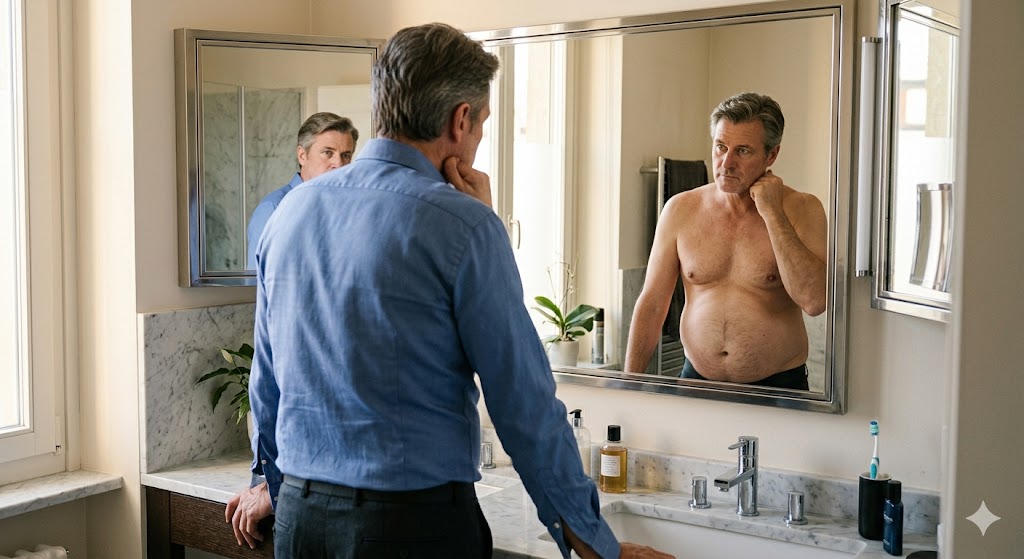
You optimise your team, your processes, your quarterly targets. You challenge budgets, make decisions that ripple through dozens of people, and somehow still find time to be on a call at 7am. You are, by most measures, a highly efficient human being. So here's a slightly awkward question — and I'm asking it as a friend, not as someone trying to sell you a protein shake: is your body running anywhere near as well as everything else you manage?
Your body is your primary asset. The one you actually own. The one you cannot delegate to a direct report, outsource to a cheaper market, or replace through a strategic acquisition. And yet — honestly — when did you last give it a proper performance review? Right. That's what I thought.
This isn't an article about wellness retreats or learning to breathe through your feelings. It's about the ROI of your body. Pareto applies here too: 20% of the right choices produce 80% of the results. And the best part? The 20% is surprisingly manageable. Stick with me.
In the suit, you look the part. The mirror at 7am operates on different standards.
In the suit, you look the part. The morning mirror operates on different standards.
Let's be honest — because between adults who respect each other, that's completely possible.
In your suit, you have the presence of someone who runs things. Sharp, put-together, the kind of person other people take seriously in a room. And you, the women reading this — in that tailored jacket, you carry the quiet authority of someone who has delivered results for years. Think of someone like Lorna Jane Clarkson — founder of a global fitness brand, who at 50-something radiates more genuine vitality than most people at 30. That's a real standard. It exists.
But first thing in the morning, stepping out of the shower — that mirror is brutally democratic. And it's not a judgement. It's just the maths of someone who's been giving 110% to their work for years: sleeping too little, eating standing up or between two meetings, while the body quietly accumulates the bill. With interest.
Gentlemen — would you take your shirt off at the next team building weekend in Zermatt without briefly tensing your core just as the photo gets taken? Ladies — does last summer's swimsuit still inspire the same enthusiasm it did when you packed it away in October? These aren't cruel questions. They're the honest ones — the kind you already ask yourself in quiet moments. And they have real answers.
« Your body is the only asset you truly own. The one making all your decisions, running all your meetings, reading reports at 11pm. It deserves a performance plan that matches what it does for you. »
The numbers you won't find in your annual report
You like data? Here's data. From serious research — not a lifestyle Instagram account.
And here's the one that really cuts through the noise: the annual cost of executive burnout to an employer is estimated at over $20,000 per senior leader. Not per company — per person. That's lost productivity, poor decisions, absenteeism, turnover. An underperforming body doesn't just cost you in wellbeing. It costs you in results.
And you — somewhere between Morges, Lausanne, Vevey or Montreux, in an expat team that probably includes at least three people living on espresso and adrenaline — you're not an exception. Statistically, you're right in the middle of this data. Welcome to the club nobody actively chose to join.
The pain points you recognise but don't mention at work
Right. Enough statistics — that was for the CFO part of your brain. What follows is for the actual human being.
The 3pm wall
You know the one. The meeting where you need a third coffee just to stay sharp. Where you accept a proposal you'd have pushed back on at 9am. That's not normal fatigue — it's your cortisol crashing after hours of unmanaged chronic stress. Your body's invoice arriving in real time.
Sleep that doesn't restore
You're sleeping — technically. Seven hours. But waking up as tired as when you went to bed. Here's what nobody explains: it's not about quantity, it's about deep sleep quality. And chronic stress destroys exactly that. You're putting in the hours without getting the repair.
The belly that just appeared
Your diet hasn't changed dramatically. You're not eating more than you used to. And yet — something has quietly settled around the middle, stubborn as a bad quarter. The explanation: chronic cortisol creates insulin resistance. The body stores directly as visceral fat. This isn't about willpower. It's chemistry.
Exercise motivation that evaporated
You used to train. Regularly. Now it lives permanently in the "when I have time" column — which, let's face it, means never. That's not laziness. Testosterone and dopamine — both crushed by chronic stress — are the biological engines behind the urge to move. When they're low, the drive just doesn't show up. Fixable. Completely.
Concentration that drifts
You used to read a 40-page report cover to cover without losing the thread. Now a single notification is enough to scatter your focus. Sleep deprivation and cortisol directly impair the prefrontal cortex — the part of your brain responsible for complex decisions and sustained attention. Your brain is running on a deficit. And it shows.
Gentlemen — the other performance
We'll address this with tact and a touch of humour, because it matters: chronic poor sleep causes a significant drop in testosterone. Testosterone drives energy, confidence, vitality — and yes, certain other performances we don't need to draw a diagram for. You've already connected those dots. Good news: entirely reversible.
It's not that you lack willpower. It's not that you don't know what to do. It's that your hormonal system has been running on emergency mode for too long — cortisol elevated, testosterone low, HGH suppressed, insulin dysregulated. In that state, trying harder doesn't change anything. What you need is to recalibrate the system. That's exactly what this is about.
Cortisol — the operational risk nobody put on your risk register
You manage risks daily. Financial, operational, regulatory. You probably have a risk register, a risk committee, dedicated processes. Good. But here's the one that's missing from that document: chronic cortisol.
Cortisol is your stress hormone. In short bursts, it's actually brilliant — it lets you think fast, decide under pressure, perform when it counts. It's part of why you're good at what you do. But when stress becomes constant — and in today's corporate world, it absolutely is — cortisol stops being an asset and becomes the problem.
Chronically elevated cortisol quietly produces: visceral fat that wasn't there two years ago. Progressive muscle loss you haven't noticed yet. Suppressed testosterone. Degraded deep sleep. Systemic inflammation. Insulin resistance. Brain fog. Decisions that are slightly less sharp by Thursday afternoon. Leadership that visibly erodes — not in crisis, but in the slow grind of a normal week.
In business terms: there's a leak in your system. Silent, progressive, expensive. And — because there's always good news — entirely fixable. With the right levers, applied consistently, by someone who knows the difference between what works and what just looks good on a wellness poster.
The Pareto principle applied to your body — the 20% that does 80% of the work
You know Pareto. You apply it every day. 20% of clients, 80% of revenue. 20% of actions, 80% of results. Your body works exactly the same way — and that is genuinely the best news in this article.
You don't need three hours of training a day. You don't need a diet that makes you unbearable at airport restaurants. You don't need to become a competitive athlete between board meetings. You need five levers — applied with reasonable consistency. That's it.
Bed before 11pm — the highest-return lever that exists
- 70% of your HGH — your primary regeneration and fat-burning hormone — is produced between 11pm and 2am during deep sleep. Go to bed at midnight and you've missed the window. Every. Single. Night.
- One hour of sleep gained before midnight is biologically worth two hours after. Studies on executives show 40.5% sleep under six hours — and make measurably worse strategic decisions as a result.
- Time investment: zero. You go to bed earlier. Return: energy, clarity, reduced cortisol, less abdominal fat, stabilised testosterone. Not bad for doing less.
The 16/8 fast — recalibrating insulin without changing what you eat
- Last meal at 8pm. First meal at noon. During the fasting window: water, black coffee, tea. That's genuinely it.
- This drops insulin levels, which frees HGH — documented increases of up to 2000%. Visceral fat starts mobilising. The brain gets sharper in the morning. (Yes, this is the opposite of everything you were told about breakfast.)
- For business travel: skipping the hotel breakfast is the simplest thing in the world. And it turns out, the most hormonally intelligent. The buffet will survive without you.
Movement 3–5x per week — testosterone, HGH, body composition
- No gym required. No machines. Fundamental free movements — squats, deadlifts, lunges, push-ups, pulls. Outdoors where possible: cortisol drops 15–20% more in a natural environment than indoors.
- The format adapts to your actual calendar: 3 × 40 minutes for a structured programme, 5 × 20 minutes for packed weeks, or 7 × 10–15 minutes if that's the reality right now. Everyone can find 15 minutes — once the excuses have been politely shown the door.
- Once you're fit (3–6 months), you maintain 90–95% of what you've built with just 3 × 15–25 minutes per week. Pareto at its most satisfying.
- And when you have that body? You get to use it for what you're actually here for: skiing the Valais, hiking the Jura, cycling Montreux to Villeneuve without needing a nap afterwards.
10 minutes of natural light — the free hormonal reset
- Step outside within 30 minutes of waking. This resets your circadian clock — the conductor of every hormone in your body for the next 24 hours.
- Walk to the lake. Stand on the balcony. Have your coffee outside. Swiss morning light — even overcast — is 10x brighter than indoor light. It counts.
- This sets a healthy cortisol rhythm — high in the morning (natural energy), declining through the day, low at night (deep sleep, HGH). Most stressed executives have this curve completely inverted. Same life, very different biology.
Protein first — the fuel your body has been waiting for
- Every meal starts with protein. Meat, fish, eggs, legumes. 1.5–2g per kg of body weight per day. This is not optional — it's structural.
- Remove added sugar and refined carbs — not as a "diet" but because every insulin spike directly suppresses HGH and testosterone production. Every time. The croissant at the 8am meeting costs more than it looks.
- And no — healthy fats don't make you fat. Insulin does. Avocado, oily fish, olive oil, eggs — these are your allies. The nutrition industry lied to you for thirty years. We can talk about that too.
« Under 3 hours per week. The right levers. A plan built for your actual life — not a professional athlete's schedule. »
Talk to PatrikWhy the outdoor studio changes everything
Here's something I've noticed consistently over twenty years working with executives and managers: the standard gym doesn't work for them. Not because they lack motivation. Because it's just another performance environment.
In a gym, you walk in already in performance mode. Mirrors everywhere. An aggressive playlist that seems designed to make you feel inadequate. An unspoken competition with whoever's on the machine next to you. You work hard — but you don't destress. Cortisol stays elevated throughout. You leave exhausted. But not actually recovered. Sound familiar? It should, because you've probably felt it.
What I offer is different. Outdoors. Private. River 20 metres away, forest within walking distance. No dress code — come in whatever you're comfortable in (worn-out t-shirt fully accepted). Studies show natural outdoor environments reduce cortisol 15–20% more than enclosed spaces. Your nervous system registers something different under an open sky. The shoulders actually drop. The jaw unclenches. And then we work — efficiently, with the full benefit of that hormonal reset already running.
My clients — expats and executives from across the Lake Geneva arc — come here regularly. Not to "do exercise". To reset. To think more clearly. To reclaim what the week took from them. And to leave in genuinely better shape than they arrived.
What it looks like in practice — 6 weeks
No magic promises. Real results, documented on profiles similar to yours, with a minimal time investment.
The hormonal reset
- Sleep before 11pm. Morning light. 14-hour fast. Protein first. First effects: less brain fog in the morning, more stable energy in the afternoon, sleep starting to actually work again.
The muscular signal
- 3 outdoor sessions per week. Fundamental movements with load. 45 minutes. Testosterone and HGH begin rising. Overall energy noticeably different.
Body composition shifts
- Visceral fat starts mobilising. Muscle mass strengthens. First visible results — the shirt fits differently. The mirror becomes less of an adversary.
Cognitive level
- Improved concentration. Sharper decisions. The 3pm wall disappears or shrinks significantly. Deeper sleep. And yes — the other performances improve too. You'd already figured that part out.
Who is behind all this — and why it matters
I'm going to say something many coaches don't: I understand your world because I came from it. I've worked in corporate — the full version, international meetings, schedules with no white space, the kind of pressure that becomes background noise after a while. I've lived in multiple countries before coming back to Switzerland, where I was born. I speak English, French and German. I've coached executives whose organisations turn over north of $120 billion. I've worked with senior leaders from Human Rights Watch, with entrepreneurs building businesses across three continents.
What that means in practice: you don't have to explain what a calendar with zero breathing room looks like. You don't have to justify why you "didn't have time". I know that schedule. I also know exactly what fits inside it — and what doesn't.
My sessions are 40 minutes. Focused, efficient, no fluff. Your time is valuable and 80/20 applies here too. Outdoors. Private. In whichever language works for you. And we laugh — because serious doesn't mean solemn, and the best sessions are the ones where you forget you're "working out" until you're already done.
We sit down and talk about you — not the programme. Where you are, what's not working, what you actually want from this. I listen properly. Then I tell you honestly what I can do for you — and if I'm not the right person, I'll say that too. No sales pitch. No pressure. Just a straight conversation between adults. And it's free.
Summary — for the executive reading at 2x speed
The 6 things this article is really saying
- Your body is your primary asset. The one you truly own. Cannot delegate, outsource, or replace. It deserves a serious performance plan.
- Chronic cortisol is the undeclared operational risk. It stores visceral fat, destroys muscle, degrades sleep, weakens focus and suppresses testosterone. It's fixable — but only if you name it first.
- Pareto applies to your body. Sleep, fasting, outdoor movement, morning light, protein — 20% of the right choices. 80% of the results. Under 3 hours per week. Really.
- Poor sleep is your number one performance enemy. It degrades decision-making, risk assessment, emotional regulation — and yes, certain other things we've already mentioned.
- The gym is not the right environment for you. Outdoor, private, natural — your nervous system recovers differently. This is documented. And it's right here, by the lake.
- It's never too late to recalibrate. Two weeks for the first effects. Six weeks for visible results. Three months for a transformation that sticks.
I want to die young... the latest possible.
— Patrik, iMove-Fit.chYour body is the only place you'll ever actually live. You might as well make it somewhere you're proud of — somewhere that performs the way you need it to, and yes, looks the part when the shirt comes off.
You have the resources to solve any problem in your organisation. You have exactly the same resources to solve this one. You just need the right partner — someone who gets your world, knows what they're doing, and with whom you can show up in a worn-out t-shirt and call things by their real names.
I'm here. If what you've just read resonates — reach out. No pitch, no pressure. Just a direct conversation to see if we're a good fit. That's how I work.