You show up. You sweat. You're consistent — well, fairly consistent. And yet after a few months, something feels off. Progress has quietly stalled. The body isn't changing the way it was. Motivation is starting to resemble that gym towel you keep meaning to wash. Sound familiar? Here's the thing: the problem is almost never effort. It's the recipe. Miss one ingredient and the whole dish falls flat — however hard you stir it.
After 20 years coaching people around Lake Geneva — executives with no time to waste, athletes who've hit a wall, people rebuilding after years away from movement — one thing has become a certainty: training more rarely helps. Training smarter always does.
But before the 5 ingredients — one question worth sitting with for a moment. What are you actually training for? Not the answer you'd give in a gym — "lose weight", "tone up", "get fit". The real answer. Mine — and the answer of every client I've worked with long enough to find out — goes something like this: I want to move freely. Run a trail without falling apart on day two. Surf a wave without throwing out my back. Play on the floor with my kids and get back up without a ten-second production. Try a handstand at 55 just because. Ski the off-piste without counting the days until my knees forgive me. A body that can actually do things — not just a body that looks like it might.
That's what this is about. Not aesthetics. Not gym performance. A body that is genuinely, practically, joyfully useful — at any age.
Why Most People Plateau — and Keep Training Anyway
The human body is a masterpiece of adaptation. Give it a new challenge — it adapts. Repeat the same challenge indefinitely — same weights, same circuit, same distance, same playlist you've been running since 2019 — and it shrugs. It has precisely zero biological incentive to change further. This is efficient physiology, not personal failure.
The response most people have? Train harder. Add another session. Push through the plateau. Which is a bit like pressing the accelerator harder in a traffic jam. The answer isn't more — it's different. And specifically, it's these five ingredients.
Ingredient 1 — Progressive Overload: the One Non-Negotiable
The most fundamental principle in all of exercise science — and the one most consistently misunderstood. The body adapts to the demands placed on it. If those demands don't increase over time, neither does the body. But here's what most people miss: progressive overload doesn't just mean "add more weight". That's one dimension. There are many more — and understanding all of them changes everything about how you train.
More load
The obvious one — increase the weight. But only when technique is perfect at the current intensity. Never at the expense of movement quality. The ego wants to add weight. The body needs the movement first.
More reps or sets
Same load, more total volume. The body must adapt to a greater workload. Gentle, effective progression — particularly for beginners who don't yet need to go heavy to get results.
More complex movement
Side plank on knees → full side plank → side plank with resistance band → side plank on unstable surface. Zero extra weight — but the challenge is real and measurable.
More instability
Stable floor → balance cushion → unstable surface → eyes closed. The nervous system, balance and proprioception are challenged without adding a single extra gram.
Less rest
Same exercise, same load, same reps — but 90 seconds rest instead of 2 minutes. Relative intensity increases. The cardiovascular system gets challenged in a completely different way.
Speed and power
A slow squat becomes a jump squat. A standard push-up becomes an explosive push-up. Power — force × speed — is a dimension of adaptation in its own right, and one most people never touch.
Range of movement
Short lunge → deep lunge → lunge with arm raise → lunge with rotation. Same pattern, but the body works through its full available range. Joints notice. Fascia notices. Everything changes.
Neuromotor complexity
Adding a simultaneous task — catching an object during a squat, reacting to a signal during a balance challenge. The frontier between physical training and cognitive training. More on this later.
A concrete example that has nothing to do with weights: working towards a handstand. The progression looks like this: solid plank → pike hold → assisted kick-up → wall handstand → free handstand for a few seconds → sustained balance. Zero barbells. Yet every step represents genuine overload for both body and brain. That's what smart training actually looks like.
Increasing too fast because motivation is high — then getting injured — then starting from zero with added frustration. Progressive means gradual. A 2.5–5% increase in load per week is ideal for strength. One extra rep per week is progressive overload. Heroic spikes followed by forced rest are not progressive overload. They're expensive setbacks wearing the costume of effort.
Ingredient 2 — Train Smart, Functional and in 3D — Not to Destruction
Two things need unpacking here that most training advice bundles separately. How hard should you push — and what should you actually be doing. Both matter enormously. Get either wrong and you're genuinely training against yourself.
How hard — the RIR revolution
For decades, the gospel was clear: real progress requires training to absolute muscular failure. Empty the tank. Leave nothing in reserve. This felt honest and serious and appropriately brutal. Unfortunately, the science has moved on — and it's been waiting outside for a while now.
An 8-week study compared two groups: one training to momentary muscular failure, one stopping with 1–2 reps in reserve (RIR — Reps In Reserve). Result: identical results in both groups. The RIR group accumulated significantly less neuromuscular fatigue, recovered faster, and maintained better execution quality across all weeks. A meta-analysis of 55 studies confirmed: proximity to failure has no clear impact on strength gains.
Translation: stopping 1–3 reps short of failure produces the same results as going to complete exhaustion — with half the fatigue and meaningfully reduced injury risk. The next time your ego insists you must destroy yourself to earn progress — you can tell it the research has moved on and is waiting outside.
Training smart isn't training easy. It's creating exactly the right stimulus to trigger adaptation — without the recovery debt that sabotages the next session. The goal is to leave with enough in reserve to come back stronger. Not to leave on a stretcher.
What to train — functional, compound and multi-plane
Here's the question the fitness industry consistently forgets to ask: strong for what? The gym answer is "strong on this machine, in this plane, at this fixed angle". The life answer is something completely different.
Machines isolate a single muscle in a fixed plane. They build gym-strong — a very specific, very limited kind of strength that transfers poorly to the things you actually want your body to do. Compound free movements — squat, deadlift, lunge, push, pull, carry, rotate, jump — engage multiple joints, multiple muscle groups, and the entire stabilising network simultaneously. They are far more transferable, produce a significantly greater hormonal response, and build a body that can genuinely do things.
But compound movements alone aren't the whole picture either. The human body evolved to move in three dimensions: forward and backward, side to side, and rotating. Most conventional training happens almost exclusively in one plane — forward and backward. The lateral and rotational planes — the ones that matter most for athletic performance, fall prevention, and functional independence — are consistently neglected. Your body knows, even if your programme doesn't.
Multi-plane, varied movement means adding lateral lunges, rotational presses, diagonal carries, single-leg work, anti-rotation challenges, and direction-change drills. Practices like Animal Flow, QiGong, and free movement exploration develop this 3D capability in ways that standard programming simply doesn't reach.
A body that can run a trail, surf a wave, carry a heavy backpack in the mountains, roll around on the floor with children, try a handstand just because, ski off-piste without the four-day recovery. Not gym-strong. Life-ready. That's what functional, compound, multi-plane training builds over time.
Ingredient 3 — Rep Ranges Are for Hormones, Not Just Muscles
Here's a perspective shift worth sitting with. When most people think about squats, deadlifts, lunges — they're thinking about their legs, their shape, their physique goals. All legitimate. But something considerably more interesting is happening in the background — and most people have no idea.
Compound movements on large muscle groups, at sufficient relative intensity, trigger a significant hormonal cascade: HGH (human growth hormone), testosterone, IGF-1. This isn't a side effect — it's one of the primary mechanisms. And this hormonal response is your natural anti-ageing protocol. HGH repairs tissues overnight, burns visceral fat, maintains bone density, feeds the brain, regenerates fascia and connective tissue. Testosterone drives muscle maintenance, energy, confidence and mood. IGF-1 supports cellular repair and telomere protection — the biological markers of how old you actually are.
So when I prescribe sets of 6–12 reps for metabolic and hormonal stimulus, or 3–5 reps for nervous system and maximum strength development — the goal isn't a particular physique. It's maintaining a hormonal environment that keeps you biologically younger than your chronological age. The squat as anti-ageing medicine. The deadlift as a longevity tool. Hard to put on a prescription pad — but the research is unambiguous.
The other dimension: speed, power and jumps. Fast-twitch muscle fibre — responsible for explosive power — is the first to go with age and the hardest to recover once lost. Sprint work, jump training, explosive medicine ball throws — these maintain fast-twitch capacity in a way that slow, controlled strength training alone simply cannot. A body that can only move slowly is a body ageing faster than it needs to.
« I don't just want to be strong. I want to move freely — at any age, for any adventure that presents itself. »
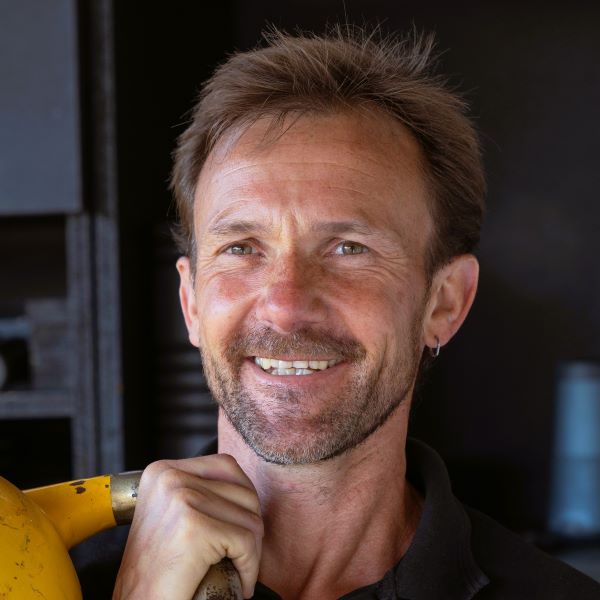
— Patrik · iMove-Fit.ch
Ingredient 4 — Recovery Is Where the Magic Actually Happens
You don't get stronger during training. You get stronger after it — during recovery. Training creates the stimulus. Recovery creates the adaptation. Skipping recovery is like planting seeds and never watering them. You can dig the beds as carefully as you like. Nothing grows without the water.
Sleep — the non-negotiable king
The king of recovery is sleep — and specifically, sleep before 11pm. Not an arbitrary bedtime rule, but because 70% of your daily HGH is produced during the first deep sleep episode, typically between 11pm and 2am. Go to bed at midnight and you miss that window. Every. Single. Night. The body doesn't reimburse sleep debt with interest. Bedroom at 18–19°C, total darkness, no screens for 60 minutes before bed, no alcohol. These aren't lifestyle preferences — they're performance variables. Ignore them and the training is doing half the work it could.
Nutrition — give your body what it needs to rebuild
Recovery is a biological construction process. It requires raw materials. Without them, the stimulus you created in training doesn't produce the adaptation you were after — it just produces fatigue. Which is a frustrating outcome for someone who actually showed up.
Protein — the building material. Within 30–60 minutes after training: 20–40g of quality protein. This is the anabolic window — when muscle protein synthesis is most responsive. Eggs, fish, meat, legumes. Not a protein bar with an ingredient list you'd need a chemistry degree to understand. Real food. 1.5–2g of protein per kg of body weight per day, distributed across meals.
Anti-inflammatory nutrition. Recovery happens in a biochemical environment. Feed it an inflammatory one — sugar, refined carbohydrates, alcohol, ultra-processed food — and repair slows, insulin spikes suppress the HGH you just stimulated, and inflammation that should resolve in 24 hours lingers for days. Feed it a clean one — abundant vegetables, healthy fats, complex carbohydrates from whole food sources — and the same training session produces dramatically better adaptation. Same session, very different result.
Food quality. The rule is simple and ancient: eat fresh, organic where possible, local when you can. Vegetables in abundance — colourful, varied, raw or lightly cooked. Quality protein at every meal. Good fats — avocado, olive oil, oily fish, whole eggs. Everything else is noise. Literally everything else.
Sugar and fast carbohydrates spike insulin — which directly blocks HGH production. Alcohol suppresses HGH by 70–75% for the duration it's metabolised, fragments deep sleep architecture, and drives systemic inflammation. One glass of wine after training is not relaxation — it's sabotage with a nice label. Choose your trade-offs consciously. Just know what they cost.
Active recovery — movement as medicine
Between intense sessions, light movement accelerates recovery — not rest. A 20-minute walk, easy mobility work, swimming, gentle QiGong. These stimulate blood flow, support lymphatic drainage, reduce fascial stiffness, and maintain movement patterns without adding significant load. "Rest day" doesn't mean "sofa day". It means "different stimulus day". Your body will thank you for the distinction.
Ingredient 5 — The Brain Is Your Most Important Muscle. Train It Too.
Here's what almost no standard training programme addresses: your nervous system is the hardware everything else runs on. Coordination, balance, proprioception, reaction time, the vestibular system — the entire network that allows you to move with precision, catch a falling object, not stumble on stairs at 75, perform in your sport, and think more clearly after a session than before it.
When you challenge balance, vision, the vestibular system and proprioception simultaneously, your cerebellum and sensorimotor cortex receive richer, faster, more varied signals. Result: neuroplasticity, better coordination, improved reaction time, and documented neuroprotective effects that slow age-related cognitive decline. Balance training produces a vestibular function equivalent to being 10 years younger in older adults. A nervous system regularly surprised and challenged ages significantly more slowly than one performing the same automated movements on repeat.
In practice: balance work on unstable surfaces, coordination drills with closed eyes, reactive sprint cues, jumps with controlled landing, speed and power work, agility ladder sequences with real-time variation — and movement that changes enough each session to prevent the nervous system from going on autopilot.
One of my favourite exercises: the client stands facing a wall. I position myself behind them — invisible — and throw a tennis ball in their direction without warning. They have to catch it without knowing where it's coming from or when. Simple on paper. In practice: a complete workout for the nervous system, reactivity, coordination and information-processing speed. And everyone laughs. Which, incidentally, drops cortisol. Two benefits for the price of one.
The same principle applies to what I call pedagogical swordplay — foam swords, no need to alert the authorities. Dodges, parries, attacks. In three minutes, the entire body is mobilised: balance, upper/lower body dissociation, visual-motor coordination, rapid decision-making under light pressure, controlled explosiveness. And everyone laughs. Because at some level, we're all children who learn best when we're genuinely playing.
Interactive boxing, agility ladders, reactivity balls, circuits that change every session — none of this is entertainment to pass the time. It's applied neuroscience. Every new stimulus creates new neural connections. Every coordination challenge forces the brain out of its automatic patterns. A brain that keeps learning is a brain that ages more slowly. That's worth a few extra foam sword bruises.

« I don't just want to be strong. I want to move freely — at any age, for any adventure that presents itself. » — Patrik · iMove-Fit · Health & Movement Coach · Morges & Ollon
The Outdoor Advantage — Because Nature Doesn't Have TV Screens
A gym is functional. Clean, climate-controlled, machines aligned. But here's what the research shows you won't find there: a cortisol reduction of 15–20% more than you get in an enclosed training environment. The brain processes "safety" differently under open sky. Shoulders drop. Jaw unclenches. And in that state, the body works better — with more hormonal recovery built into the session itself, without any extra effort.
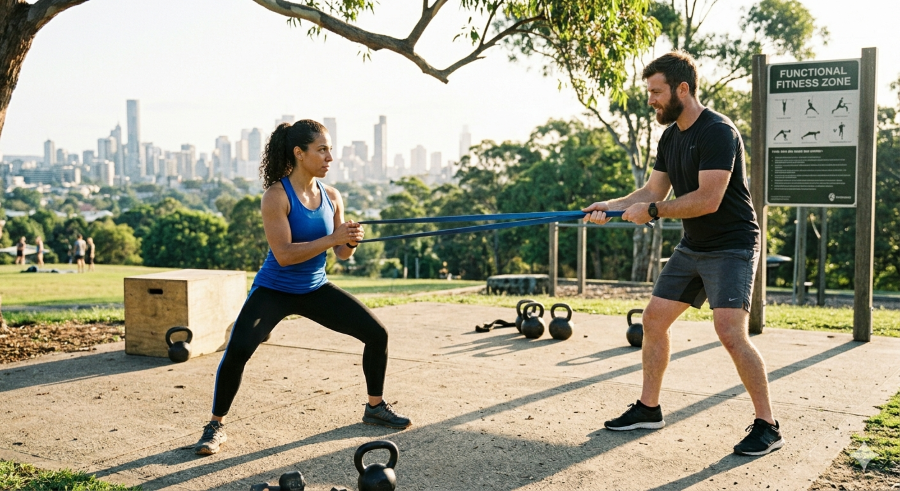
On natural surfaces — grass, gravel, uneven ground — stabilising muscles activate continuously. Proprioception works without being asked. Balance self-regulates constantly. It's passive neuromotor training included in every single session at no additional cost. You get it for free just by being outside.
And there's something a gym with television screens mounted on the walls simply cannot offer: genuine sensory stimulation. Outdoors, the nervous system is continuously fed — natural light that shifts, fresh air, ambient sounds, a landscape that changes. The brain is engaged, alert, present. Compare that to a gym where screens exist to "pass the time" — which is essentially an admission that the training itself isn't interesting enough to hold attention. A workout that needs a television to be tolerable probably isn't stimulating the brain enough to be worth the drive.
This is where Movement Training finds its natural home — Animal Flow, QiGong, ground work, free 3D exploration. The body recovering the movement variety that modern life quietly stole from it. Every joint notices. Every fascial line notices. Every session outdoors adds something the most expensive indoor facility cannot replicate.
The Unfair Advantage — What a Truly Great Coach Brings to This Recipe
All five ingredients above can theoretically be applied alone. In practice, one variable changes the outcome more than any single ingredient: the right person in the room with you.
Not because a coach pushes harder. Because a great coach reads. They notice how you walked in this morning — something slightly different in the shoulders, a quality of tiredness that says "adapt the session" before you've said a word. They adjust in real time, not on a spreadsheet. A client arriving depleted after a brutal week gets something fundamentally different from one who slept well and is ready to go. An app cannot do this. A programme sheet cannot do this. A human who actually knows you can.
And then there's the variety. The session changes every time — different tools, different stimuli, different challenges — because the body and brain adapt fastest to inputs they haven't encountered before. A nervous system that's surprised is a nervous system that grows. When you're catching tennis balls thrown from behind without warning, reacting to a sword you didn't see coming, navigating an agility ladder while your coach calls out changes mid-sequence — you're laughing. You're focused. You're genuinely present in a way that the third set of the same exercise never quite demands.
The result? You leave tired — but energised. Physically spent — but mentally refreshed. You walk out with a smile, even when your legs file a formal complaint. And you look at the next session in your diary not with dread but with something that feels suspiciously like anticipation. That's not coincidence. That's what great coaching is supposed to produce.
What Does a Smart Training Week Actually Look Like?
Theory is only useful when it translates into practice. Here's how these 5 ingredients combine into a realistic week — adaptable to your schedule, energy and goals. Not a fixed prescription. A framework you can shape around your actual life.
Strength + movement + brain
- Session 1: Compound strength — squat pattern, hinge pattern, upper body push/pull. 4–5 exercises, 3–4 sets, 6–10 reps at 1–2 RIR. Finish with 5–8 minutes of explosive work (jumps, sprints, medicine ball).
- Session 2: Movement & coordination — multi-plane, 3D, varied. Animal Flow patterns, balance challenges, rotational work, agility. Less load, more variety and reactivity.
- Session 3: Full body compound + neuromotor challenge. Different exercises from Session 1. Reactive elements integrated — coordination drills, balance under fatigue, interactive work.
- Every day: 20 minutes of walking. Light mobility. Morning light exposure. That's genuinely it.
Short, focused, daily
- Mon/Thu: Strength focus — 3–4 compound movements, 3 sets each, 6–10 reps. Done in 20 minutes with 60-second rests.
- Tue/Fri: Movement & coordination — mobility, balance, multi-plane, varied functional work.
- Wed: HIIT or sprint intervals — 6–8 × 20-second efforts with 90-second recovery. Powerful HGH stimulus in under 20 minutes.
- Sat/Sun: Active recovery — walk, swim, hike, bike. Movement without performance pressure.
2 sessions — non-negotiable
- 2 × 40 minutes per week: Full body compound movements. Progressive overload every session. Varied enough to keep the nervous system engaged. This is the minimum that produces measurable results over months.
- Daily: 20-minute walk. 5 minutes of morning mobility. These cost nothing and preserve everything.
- Consistency over months at this level beats heroic weeks followed by disappearance. Every. Single. Time.
Frequently Asked Questions
The best training isn't the one that destroys you the most. It's the one you leave better from — and can't wait to come back to.
— Patrik · iMove-Fit.ch