You've probably never given much thought to your fascia. Most people haven't — until something starts hurting and nobody can quite explain why. The shoulder that aches despite a perfect MRI. The lower back pain that comes and goes without obvious cause. The mysterious tension between the neck and the hips. Often, the answer is right there, wrapping every structure in your body — quietly, continuously, invisibly. It's called fascia. And once you understand it, the way you think about movement, pain and ageing changes completely.
What exactly is fascia?
Fascia is a network of connective tissue — primarily collagen — that envelops, supports and connects every structure in your body. Every muscle, every bone, every organ, every nerve, every blood vessel is wrapped in fascia. It's not an isolated tissue; it's a continuous three-dimensional web that runs from the top of your skull to the soles of your feet without interruption.
Think of it like the inner skin of an orange — the white membrane that separates and holds the segments. Remove it and the orange loses its structure. The same is true for your body: without healthy fascia, muscles don't function correctly, joints lose stability, and the forces generated by movement can't be transmitted efficiently through the body.
Fascia is composed primarily of collagen (which provides tensile strength), elastin (which gives elasticity), and a gel-like ground substance called hyaluronic acid — which allows the fascial layers to slide over each other smoothly. It contains mechanoreceptors, proprioceptors, and even contractile cells called myofibroblasts. It's not passive packaging. It's a living, sensing, contracting tissue.

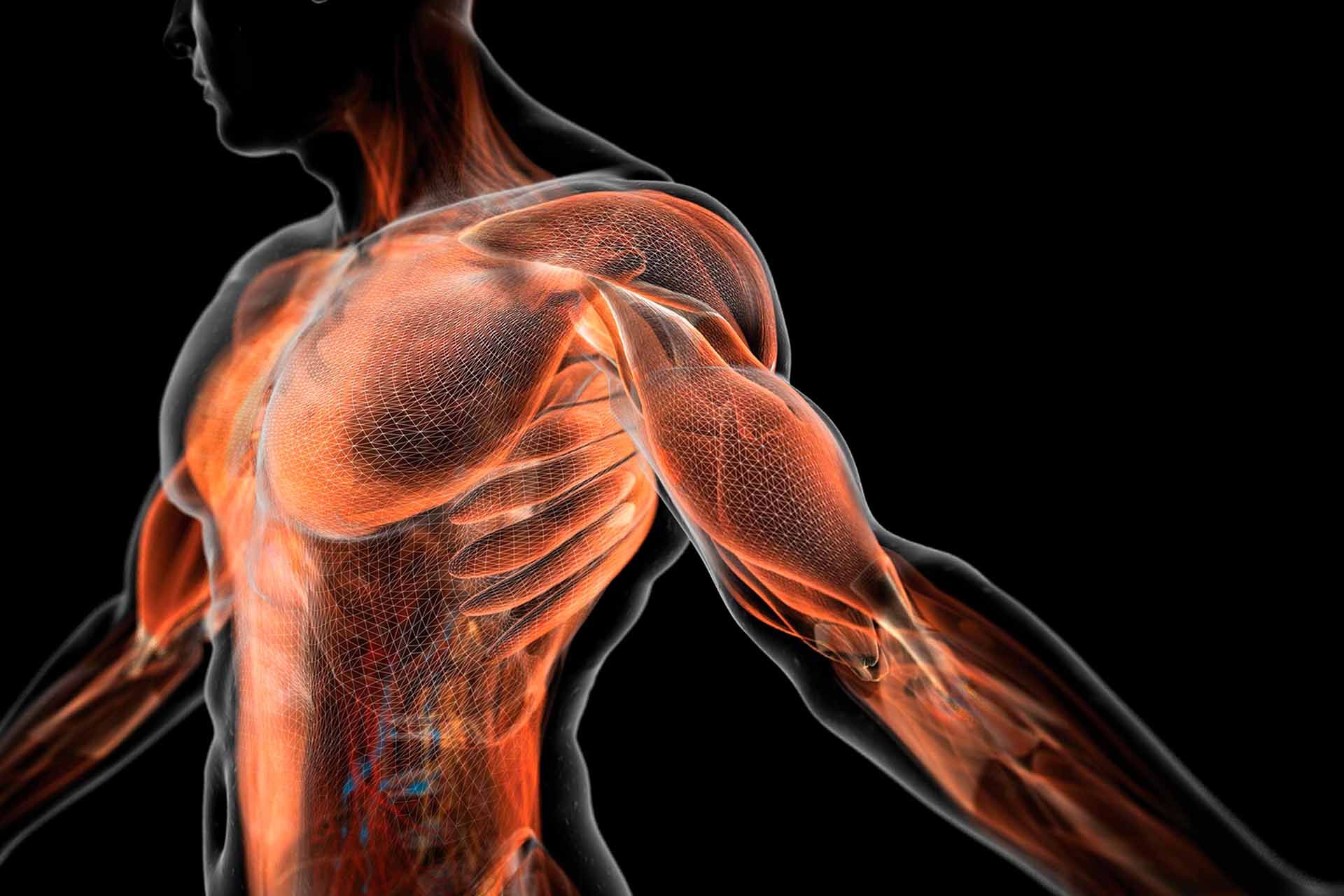
The fascial network — a continuous web of collagen and elastin that connects every structure in the body. Its health depends directly on movement variety and hydration.
Why fascia causes pain — often somewhere unexpected
This is the aspect of fascia that surprises most people: fascial pain is rarely felt exactly where the problem is. Because fascia is a continuous network, a restriction or adhesion in one area creates tension along entire fascial lines — lines that can span from foot to neck, from hand to spine.
A classic example: plantar fasciitis (pain in the sole of the foot) is often connected to calf tension, hamstring tightness, or even restrictions in the lumbar fascia. The source of the problem is not where the pain is felt. This explains why so many musculoskeletal problems don't respond to treatments that address only the local area.
When fascia becomes dehydrated, immobile or subject to repetitive strain in a single plane of movement, it develops adhesions — areas where the fascial layers become stuck together, losing their ability to slide. This creates areas of increased mechanical tension that transmit to adjacent structures, producing pain, restricted movement and altered biomechanics throughout the body.
Fascial lines — the motorways of the body
Thomas Myers, in his seminal work Anatomy Trains, identified twelve major myofascial meridians — continuous lines of fascial connection that run through the body in specific directions. Understanding these lines explains many otherwise mysterious pain patterns.
Superficial Back Line
Runs from the soles of the feet up the back of the legs, along the spine and up to the eyebrows. Tension anywhere in this line — tight calves, short hamstrings, lumbar restriction — transmits through the entire line. A common source of neck and headache complaints that originate in the lower body.
Superficial Front Line
Runs from the top of the feet up the front of the body to the skull. Shortened hip flexors (from prolonged sitting) pull on this line, creating tension in the abdomen, chest and neck. The chain of "desk posture" dysfunction traces largely through this line.
Lateral Line
Runs up the outside of the body from the fibula to the skull. IT band issues, hip impingement and lateral knee pain are often expressions of lateral line restriction. The lateral line also mediates balance and lateral stability.
Spiral Line
Wraps around the body in a double helix. Rotational restrictions — the inability to turn the torso freely — often involve the spiral line. Highly relevant for rotational sports and for the 3D movement work that keeps fascia healthy.
An ankle sprain can affect your hormones. Here's why.
This sounds extreme but it isn't. The deep front line — one of Myers' fascial meridians — connects the inner arch of the foot through the inner leg, pelvis, lumbar spine, diaphragm, pericardium (the sac around the heart), and the pituitary gland. An ankle sprain that creates fascial restriction in the foot can, through this continuous line, influence diaphragm function (breathing), thoracic mobility, and — over time — even endocrine signalling. This is why a truly holistic approach to movement assessment looks at the whole body, not just the area of complaint.
Fascia ages — and it's this that makes you feel "old"
Healthy fascia is like well-hydrated, elastic netting — flexible, responsive, able to transmit forces efficiently. With age — and specifically with insufficient movement, dehydration, chronic stress and declining hormones — fascia changes in ways that produce the physical experience most people associate with getting older.
The collagen fibres begin to lose their organised parallel structure and develop cross-links — disorganised bonds between fibres that make the tissue stiffer and less responsive. The hyaluronic acid ground substance dehydrates, reducing the ability of fascial layers to slide smoothly. Myofibroblasts become more active, creating a low-level contractile tone throughout the tissue that contributes to the feeling of chronic tightness.
The morning stiffness that takes 20 minutes to resolve after 50? That's largely fascial. The feeling that your joints are "older" than you are? Fascia. The loss of the fluid ease of movement that characterises youth? Fascia.
The important nuance: this is not inevitable, and it's partially reversible. Fascia responds to the right inputs — particularly varied movement, adequate hydration with electrolytes, and specific manual techniques.
Varied movement — the most powerful remedy
Here's the central principle of fascial health: fascia adapts to the movements you do — and degrades in the directions you don't.
A person who runs and does nothing else develops fascia that's strong and mobile in the sagittal plane (forward and backward) and increasingly restricted in everything else. A person who sits at a desk develops fascia adapted to a single static position — shortened hip flexors, compressed spinal fascia, restricted shoulder and chest tissue. The specificity of adaptation works both ways.
The solution is not stretching in a few directions. It's three-dimensional, varied, multi-plane movement — the kind that takes every joint through its full range, in multiple directions, under varying loads and speeds. The kind that humans were designed for, and that modern life systematically eliminates.
« Fascia doesn't care about your workout programme. It cares about the variety of movements you ask it to support. »
Animal Flow, QiGong and free movement — why they transform fascia
This is why practices like Animal Flow, QiGong, Tai Chi, and exploratory free movement are among the most valuable things available for fascial health — not because they're "trendy", but because they do what conventional gym training typically doesn't: they move the body in three dimensions, under varying speeds and loads, with attention on the quality of the movement rather than just the mechanical output.
Animal Flow, specifically, involves quadrupedal movements, ground-based transitions, rotations, lateral patterns, and flowing connections between positions that systematically challenge the fascial lines in multiple directions. It's what a child does naturally on a playground. Adults forget — and then wonder why they feel stiff.
QiGong and Tai Chi offer a different quality: slow, internally attended, continuous movement that takes the joints through full range under minimal load. The slow speed is not a limitation — it actually allows the nervous system to register and respond to subtle proprioceptive inputs that fast movement bypasses. The fascial system, which is dense with mechanoreceptors, responds particularly well to this slow, attentive quality.
Techniques for keeping your fascia in excellent health
Primary and natural movement — the foundation
Before any technique, before any equipment: move in ways that mimic how humans evolved to move. Walk on varied terrain. Squat low and get back up. Crawl. Reach, pull, push, carry. Rotate. Change direction. The body's fascial architecture developed over millions of years of exactly this kind of movement variety. Reintroduce it deliberately.
Cervical circles and the infinity figure-eight — releasing the whole body from the top
Slow, full cervical circles (moving the head in complete circles) and figure-eight movements free restrictions in the cervical fascia that radiate down through the superficial back line. This is one of the fastest interventions for releasing tension that has accumulated through a day of desk work. The key is slowness — the movement should take 30-45 seconds per complete circle to properly mobilise rather than just stretch.
Self-release — tools for home use
Foam rolling and fascia balls (harder than yoga balls, smaller and more targeted) allow direct mechanical input to fascial adhesions. The technique matters: slow, sustained pressure at points of restriction — not rapid rolling. Hold the pressure point for 60-90 seconds until you feel the tissue release, then continue. The goal is not pain — it's the characteristic "sweet spot" sensation of reaching a restriction and waiting for it to soften.
Massage and holistic approaches
Manual therapy by a skilled therapist — particularly approaches that work with the fascial lines rather than individual muscles (myofascial release, structural integration, Rolfing) — can produce rapid and lasting changes in fascial organisation that self-release cannot achieve. For people with significant chronic restrictions or pain patterns, this is a worthwhile investment.
Nutrition — what you eat shows up in your fascia
The acid-base balance — the least-known secret
The biochemical environment of the ground substance — the gel-like matrix in which fascial fibres are suspended — is significantly affected by pH. A chronically acidic internal environment (high sugar, processed foods, excess animal protein without plant buffering, chronic stress) promotes inflammatory signalling that degrades collagen and cross-linking of fascial fibres. An alkaline-leaning diet — abundant vegetables, adequate hydration with minerals, reduced sugar and processed foods — supports a favourable fascial environment.
Essential nutrients for healthy fascia
Vitamin C is indispensable for collagen synthesis — it's a co-factor for the enzymes that cross-link collagen fibres correctly. Without adequate vitamin C, collagen is synthesised but poorly organised. Peppers, kiwis, citrus, berries. Bone broth provides directly bioavailable collagen precursors — gelatin and the amino acids glycine, proline and hydroxyproline that are the building blocks of fascial tissue. Omega-3 fatty acids reduce the systemic inflammation that degrades fascia. Sulphur-rich foods (eggs, onions, garlic, cruciferous vegetables) support the sulphated proteoglycans in the ground substance. Hydration with electrolytes — particularly the mineral-rich hydration from unrefined sea salt (Guérande or similar) — keeps the ground substance adequately hydrated. The fascia is 70% water. Dehydrated fascia is rigid fascia.
The role of a coach — why it genuinely changes things
Fascia is invisible and its restrictions rarely produce obvious, locatable symptoms. This is precisely why working with someone who can assess movement patterns across the whole body — not just the area of complaint — makes such a difference.
A skilled coach looks at how you walk, how you transition between positions, where your movement is fluid and where it's restricted. They notice asymmetries that you've adapted to so completely that you no longer perceive them. They can identify the upstream cause of downstream symptoms — the hip restriction that's actually driving the knee pain, the thoracic immobility that's loading the neck.
Reducing pain AND improving performance — simultaneously
The approach that works for fascia is the same approach that produces the best athletic performance: varied, integrated, multi-plane movement with attention to quality. This is not a rehabilitation programme — it's an optimisation programme. The same work that relieves chronic tension and resolves pain patterns also improves coordination, balance, power transfer and the efficiency of every movement you make. Pain reduction and performance enhancement are not separate goals. They share the same solution.
What science is still discovering — and what will surprise you
Fascia contracts independently — and responds to your emotions
Research over the past two decades has revealed that fascia contains myofibroblasts — contractile cells that can generate significant tensile force, independently of the nervous system. This means fascia is not just a passive transmitter of muscular force — it actively participates in the mechanical state of the body. More remarkably: myofibroblast activity is sensitive to emotional states and chronic stress. The body-mind connection in physical tension is partly a fascial story. Chronic anxiety, unprocessed emotional stress, and trauma can create sustained myofibroblast activation — the biological substrate of what many body therapists have described for decades as "held tension" or "stored stress".
Grace, fluidity and martial arts — fascia as instrument
The extraordinary physical qualities displayed by experienced practitioners of Tai Chi, QiGong, martial arts, gymnastics, and dance are not simply muscular strength. They involve the fascial system working as a tensegrity structure — distributing forces across the entire network, storing and releasing elastic energy with precision. The "springiness" of an elite athlete, the fluid continuity of a dancer, the effortless power of a martial artist — these are fascial qualities, developed through years of deliberate, varied, attentive movement. This capacity is available to everyone, at any age. It simply requires the right input.
The body doesn't move in muscles. It moves in patterns. And fascia is the fabric those patterns are written in.
Frequently asked questions about fascia
Can fascial restrictions be fully resolved?
Many can — particularly when caught before they become chronic. The fascial system has significant capacity for remodelling given the right inputs: varied movement, appropriate manual therapy, adequate nutrition and hydration, and stress management. Some long-standing restrictions may become permanent architectural features, but even these can be worked around and managed to restore functional, pain-free movement.
How is fascia work different from regular stretching?
Static stretching targets individual muscles in a single plane and duration. Fascial work targets the whole-body network in three dimensions, with attention to the lines of tension rather than isolated muscles. The techniques are different (slow, sustained pressure and movement rather than brief holds), the goals are different (restoring sliding between layers and 3D mobility rather than lengthening a specific muscle), and the results are qualitatively different — a change in the fluid quality of movement that static stretching rarely produces.
Does fascia work help with chronic pain?
For many types of chronic musculoskeletal pain — particularly the kind that doesn't respond to conventional treatment and doesn't show clearly on imaging — fascial assessment and treatment is often the missing piece. This is particularly true for pain that appears in multiple locations, pain that moves, and pain that seems disproportionate to any structural finding. A full assessment by a practitioner who understands fascial mechanics is worthwhile if conventional approaches haven't produced results.
How does menopause affect fascia?
Significantly. Oestrogens directly stimulate collagen production — their decline during perimenopause and menopause accelerates collagen loss by approximately 30% in the first five years. This affects fascia throughout the body: joints become less stable, fascia loses elasticity, and the characteristic stiffness and joint pain of menopause is largely a fascial story. Strength training, adequate protein and vitamin C intake, and Celtic sea salt hydration are the primary interventions.