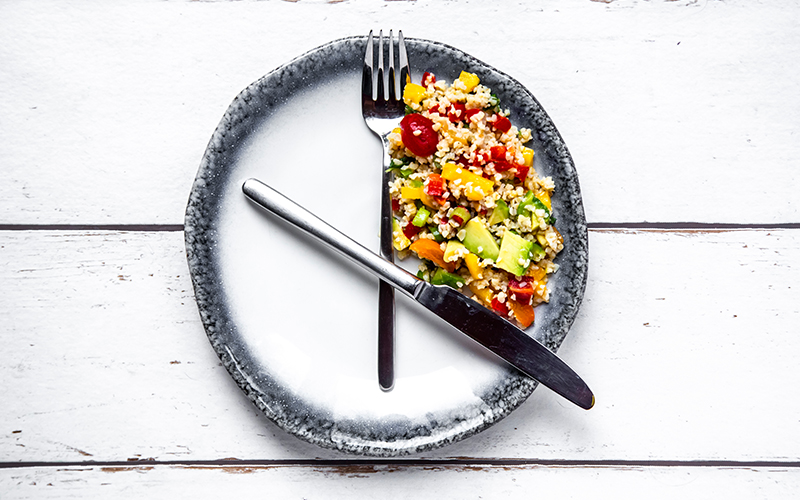
Fasting — the word conjures images of deprivation, hunger, white-knuckling your way through a day with nothing but willpower and black coffee. That's not what this is. Intermittent fasting as I practise it and teach it is barely a "fast" in the traditional sense. It's just eating with common sense — within a time window that matches your biology. And once you've integrated it, you stop seeing it as a constraint. You start seeing it as a kind of freedom.
Window fasting — where to begin
After testing multiple approaches on myself and hundreds of clients, my recommendation is clear: start with window fasting. It's the most realistic approach, the easiest to integrate into a normal life, and the one that causes the least discomfort for beginners.
The principle is simple. You eat your meals within a defined time window — and outside that window, you only drink water. No calorie counting. No forbidden foods. Just a window.
During the fasting window, insulin drops. HGH rises. The body starts drawing on fat reserves. Autophagy begins to activate gradually. And when you break your fast, your body is in an optimal hormonal state to absorb nutrients and rebuild muscle. It's this sequence — not calorie restriction — that explains the results.
Recommended window: 8 hours for men (16-hour fast), 10 hours for women (14-hour fast). Why the difference? Research shows women are more sensitive to restriction signals. Too strict a window can disrupt the female hormonal cycle. 10 hours delivers all the benefits without that risk. Post-menopausal women can gradually move to 9 hours if they wish.
How to choose your window
First — use common sense. Eating at 10pm or later makes no biological sense. Our bodies are designed to eat during the day and recover at night. For genuinely restorative sleep, your last meal should be 3 to 4 hours before bed. And if possible, before 8pm — because it's around 11pm that HGH begins its main nocturnal production. Eating late = insulin high = HGH suppressed. Simple.
Then choose the window that actually fits your life — not some idealised version of a life you don't have. If you have 7:30am meetings, a window starting at 9am is more realistic than one starting at 7am.
Examples for women — 10h window
- 7am → 5pm | fast 5pm → 7am
- 9am → 7pm | fast 7pm → 9am
- 10am → 8pm | fast 8pm → 10am
Examples for men — 8h window
- 7am → 3pm | fast 3pm → 7am
- 9am → 5pm | fast 5pm → 9am
- 12pm → 8pm | fast 8pm → 12pm
When fasting, you tend to have excellent rational focus and concentration — great for analytical work, important decisions, tasks requiring sustained attention. Your creativity, on the other hand, can be slightly muted. Plan accordingly when you can. And no — it's not in your head. It's neurochemistry.
How to break your fast — and why it matters
This is the step most people rush — and it's a shame, because this is where it all comes together. Your body, after 14 to 16 hours of fasting, is in an optimal hormonal state. Insulin is low, HGH is elevated, cells are primed to absorb nutrients efficiently. What you eat first will determine whether you maintain that state — or immediately sabotage it.
The golden rule: start with protein. Eggs, fish, meat, legumes. A colourful meal with good fats — avocado, olive oil, oily fish. Avoid breaking your fast with fast sugars (juice, white bread, breakfast cereals) which create an immediate insulin spike and suppress the very HGH you just spent hours building up.
Think of your first meal as premium fuel going into a freshly cleaned engine. You wouldn't put regular in it.
Real results — but not magic ones
Intermittent fasting can be a genuine body and health transformer — provided you pair it with clean eating. And if you want a truly toned physique, you absolutely need to combine it with a strength training programme.
Why strength training rather than just cardio? Because muscle burns calories at rest. The more lean muscle you have, the higher your basal metabolic rate — and the more fasting's effects get amplified. Cardio burns calories during effort. Strength training permanently changes your metabolism. Not the same thing at all.
"The goal isn't to starve yourself. It's to find something that works for you — and give it the time to do its job."
— Patrik
The 8 classic mistakes — and how to avoid them
In 20 years, I've seen the same mistakes repeat themselves. Here they are — with what I wish someone had told people sooner.
1. Expecting magic results
"I've been doing it four weeks and only lost 3 kilos..." Seriously? There are plenty of people who would be thrilled to lose 3 kilos in a month while eating normally and not running marathons. Intermittent fasting works — but it doesn't create miracles. 3 kilos in 4 weeks without changing much else is a genuinely excellent start.
2. Eating anything during the window
Fasting amplifies the effects of good nutrition. It doesn't replace it. If your eating window consists of fast food and processed snacks, fasting won't compensate. Too many empty calories means more stored fat — even with a perfect fast. The window is the frame. What you put in it still matters.
3. Staying completely inactive
If you spend your fasting day on the sofa watching TV, you'll think about food every ten minutes. Stay active. Your body has more than enough energy to work, walk, garden. Keep your mind occupied — and your fasting window will pass without the fridge haunting you.
4. Not drinking enough water
Dehydration is frequently confused with hunger. Before deciding you're starving, drink a large glass of water. Wait 10 minutes. In 80% of cases the sensation disappears. Your body is 60% water — not sugar. Drink. A lot. Then drink more.
5. Overdoing the coffee
One black coffee is reasonable and can actually help you through the fasting window. Three or four coffees a day because you didn't sleep, and you're disrupting your sleep — which sabotages your nocturnal HGH production. Fasting and coffee coexist well. Excess coffee and restorative sleep do not.
6. Too ambitious too fast
Wanting to do a 48-hour fast in week one because you read "the longer the better" is like deciding to run a marathon without ever having run 5km. Start by pushing breakfast back an hour. Then two. Then move to a proper fasting window. Gradual and consistent always beats heroic and unsustainable.
7. Doing too much
Fasting is intermittent — not permanent. Benefits begin to diminish beyond 20 to 24 hours of continuous fasting for a daily practice. Beyond that, the body may activate survival mode. The 72-hour therapeutic fast is for once or twice a year — not a weekly habit.
8. Obsessing over the clock
"I've been watching the clock since 1:30pm knowing I can't eat until 2pm." You don't have permission? Seriously. A 20 to 30-minute variation won't undo weeks of effort. The cortisol you generate by stressing about the time will do you more harm than the deviation itself. Follow the broad principles. Life is good.
The 24-hour fast after a big night
A classic situation. The big evening, the excesses, the morning after that feels like a punishment. Here's what I do — and what I recommend.
First rule: don't feel guilty. It happened, you had a good time — don't spoil it now. Go back to your normal routine. And don't make it a habit.
If you feel like it, go straight into a 24-hour fast. From when you wake up — lots of water, herbal tea, and a long walk in nature if you can manage it. Your next meal is breakfast the following morning. This helps your microbiome (which took a hit) regenerate more quickly. And it restarts autophagy to clean up what needs cleaning.
If it doesn't work for you, don't do it. Fasting should always be something you choose — not something you endure.
Want to adapt fasting to your schedule, travel calendar and specific goals?
Talk to PatrikFrequently asked questions
Sources & References
- Longo & Panda (2016) — Fasting, Circadian Rhythms, and Time-Restricted Feeding. Cell Metabolism
- Harvie & Howell (2017) — Potential Benefits and Harms of Intermittent Energy Restriction. Proceedings of the Nutrition Society
- Ohsumi Y. (2016) — Nobel Prize in Medicine — mechanisms of autophagy
- Ho KY et al. — Fasting enhances growth hormone secretion. Journal of Clinical Investigation, 1988